A Faster Way to Slash Shot-Blasting Costs
Key Highlights
- Innovative wear parts help reduce operating costs by extending the lifespan of hot components like blades and impellers.
- Testing allows rapid iteration and validation of new materials and designs, accelerating the deployment of cost-saving solutions.
- Understanding total cost of ownership, including abrasive and energy consumption, guides strategic improvements in blast wheel efficiency.
- Advanced material science and microstructure analysis allow for precise prediction and enhancement of wear life, leading to fewer replacements and lower costs.
- Cost savings are achieved without sacrificing performance, as optimized wear parts improve energy efficiency and reduce downtime.
Wheel blasting is a highly efficient method for cleaning castings, especially in high-volume production. That is because foundry shot-blast machines are among the most powerful of their kind - with the running cost to match. Annual costs for abrasive, energy, parts, and maintenance are significant. Currently, digital process monitoring and machine upgrades are the main routes for controlling these costs. Wheelabrator has been working on another approach: blast wheel wear parts that reduce running costs from the inside. Without upgrades.
When you think about the cost of running your shot-blasting operation, what are the big items that spring to mind? Is it wear parts invoices and maintenance hours, or perhaps the annual bill for abrasive? It’s easy to focus on the most visible invoices - and much harder to get a total view of the cost of your process and the levers you can pull to really save money.
The economics of wheel blasting depend on many factors, but the blast wheel itself is at the core of performance and cost efficiency. Upgrading older machines with modern wheels can dramatically improve results, but these upgrades require production downtime and demand capital investment. So how can innovative, cost-saving wheel technology be applied to existing machines more easily and often?
At Wheelabrator’s global tech and test center for wheel technology in Germany we’ve been working on exactly that: a new way of optimizing the cost performance of existing wheels faster and with higher frequency. By fine-tuning core wear parts to reduce operating costs significantly.
The Wheelabrator Technology Center Wheel in Metelen, Germany, recently invested to improve its metallography research and testing capabilities, to advance development of wear parts for blasting systems.
These are some of the insights and ideas behind the development of these next-generation parts systems, which are already available for selected wheels in our portfolio, with more to come.
Understanding blast-wheel running cost
To change the economics of wheel blasting, we must understand them first. Again, the main driver is the wheel. The total costs of running a blast wheel can be expressed as a pie chart. This chart varies across the different wheel types and applications. Its composition offers important clues about what cost items to tackle first and what strategies to pursue.
For example, for the super-high-powered blast wheels (37 kW/50 HP and above) commonly found on high-volume foundry machines, abrasive and energy consumption are the biggest cost drivers, with wear parts costs contributing only a thin slice to the overall cost. On lower-powered wheels, wear parts costs typically take a more significant share.
For all wheel types, the most frequently changed “hot parts” (blades, impeller, control cage) make up the biggest part by far of all parts costs.
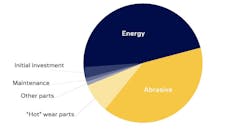
This pie chart in Figure 2 graphs the costs for Wheelabrator ATLAS 70 V-belt drive blast wheels. It’s designed for low-speed, high-horsepower applications, to achieve extremely high abrasive throughputs. It illustrates why, for high-powered foundry applications, the initial R&D focus was to slash abrasive consumption.
For lower-powered wheels, we looked at ways of significantly reducing parts cost first. Importantly, though, we never lose sight of the cost pie chart. This “total cost of ownership” approach maps the annualized cost for operating the blast wheel over its service life, rather than looking at the cost of, for example, a wheel blade in isolation. It’s no use to develop cheaper parts if they increase abrasive consumption or result in more parts purchases across the year. Instead, a strategy might be to reduce the annual parts costs by increasing wear life.
If the goal is to deliver continuous, genuine cost savings that hit your bottom line, we must avoid false economies and always do the math for the whole.
Fast design evolution, powered by testing
Understanding the true blast wheel costs is one thing; engineering wear parts that consistently reduce them is another. Our test center allows us to do this at speed. On countless test machines, we can replicate virtually any customer process, rapidly iterate new combinations of materials, geometries, and designs, and validate performance through rigorous testing—accelerating innovation from concept to proven solution.
This is particularly important because we knew early on that we needed to treat the core hot parts as a system. Together, they determine the journey of the abrasive particles inside the wheel. The bumpier the journey, the more wear everywhere. Smoothing this path reduces wear on abrasive and components, resulting in more of the input energy arriving where it’s wanted: on the casting surface.
Testing allows us to fine-tune the interplay of these core parts and optimize them towards a specific goal. For example, one of our first objectives was to optimize the hot parts for one of our highest-powered foundry wheels to deliver significantly lower abrasive consumption. The result is the ATLAS Command system which can reduce abrasive spend on ATLAS 70 wheels by up to 40%.
The Command system also benefited from a systematic assessment of materials to extend service life of components. This helped us unlock another benefit: we were able to both extend and synchronize the wear life of the hot parts, so they can be exchanged at the same time without giving up wear life on any one of the components. Similarly, a second new parts system developed for one of our lower-powered wheels doubles the wear life of the hot parts, thereby halving annual parts purchases - a big slice of the annual cost for that particular wheel.
Same parts, different lifespan … why?
An important and ongoing part of Wheelabrator’s research is to better predict and dramatically extend the service life of blades - the wear parts with the shortest lifespan. Early on, our systematic wear tests threw up surprises that led to the wear life breakthrough described above.
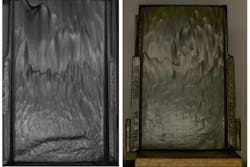
Figure 3 shows the wear pattern of two blades. They are formed with the same alloy, blade geometry, and testing time and appeared identical when new. Yet the blade on the right outperformed the one on the left by a factor of 2.5. The left blade’s wear pattern is uneven and material thickness has already reached the 75% wear limit at its upper edge.

Viewed under the microscope (in Figure 4), the reason for this enormous variance becomes clear: very different microstructures. The blade with a long service life has a much finer grain structure. What made the difference was the specific casting, cooling, and heat-treatment process used to manufacture the superior blade.
The evidence base from these tests now enables us to predict wear life of parts much more accurately - and to monitor part quality not just in long tests but instantly, through analysis of samples. We continue to test new materials at the test center, in pursuit of ever better wear and, crucially, cost performance.
By combining material science, rigorous testing and a forensic view of blast wheel running costs, we have found a new way to reduce operating costs significantly. Wear parts innovation has opened up new possibilities for continuous improvement of wheel blast processes. It has become a core part of our wheel offering and will be rolled out across more of our wheels.
About the Author
Christian Timmer
Head of Testing
Christian Timmer is the Head of Testing at Norican Group’s Wheelabrator Technology Center, Metelen, Germany.