High-Volume, High-Availability Sand Removal for Heavy Parts
Key Highlights
- Machine tailored for de-sanding large, iron castings up to 150 kg, ensuring thorough cleaning and surface quality.
- Features include reinforced transport belts, perforated deflector pulleys, and eight turbines with 340 kW total power for precise and efficient blasting.
- The blast chamber is constructed from manganese steel with replaceable wear plates and tool steel liners, ensuring durability and sustained uptime.
- Auxiliary equipment (e.g., crane trolleys and safety sensors) facilitate quick turbine maintenance and enhance worker safety.
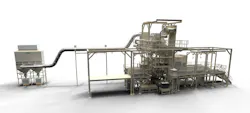
Even after 110 years in operation, Funosa S.A. has to consider new approaches to its production processes. For the high-volume and high-availability process of de-sanding ductile and gray iron castings, the Spanish foundry is installing a sturdy and energy-efficient shot-blast system developed by Rösler.
Over the past decade Funosa has been investing to modernize its systems and streamline its operation, and Rösler’s RDGE 1250 wire-mesh belt, continuous flow shot-blast machine is in line with those efforts.
“For us the new blast machine is another important step to make us fit for the future,” technical manager Antonio Ortega explained. “The Rösler system is replacing an old, obsolete blast machine and will be substantially more productive, less noisy, and much safer.”
A major factor in developing the new machine is the intended use for blast-cleaning flat but heavy iron (up to 150 kg/330 lbs.) components, like control arms for commercial vehicles. This required a reinforced transport belt engineered to maintain structural integrity throughout the blasting process, ensuring optimal impact angles and continuous operation without slippage.
More than that, the belt carrying the heavy castings must glide easily around a deflector pulley. A specially designed, perforated pulley, and a pneumatic belt-tensioning device ensure that the belt carries workpieces through the blast machine without slippage.
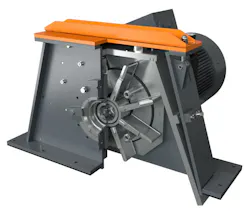
The workpieces will pass through the blast chamber at 6 meters/min. Eight Rösler EVO-42 turbines - four above the belt, four below - project blast media with precision, as hardened tool steel blades ensure thorough surface cleaning of castings. The turbines have a total power of 340 kW and are equipped with a vibration-control device.
Robust blast chamber
The RDGE blast machine was specially designed to meet the processing demands at Funosa, including sustained uptime. The blast chamber is fabricated from 8-mm thick manganese steel, and the entire blast zone is lined with 15-mm-thick, overlapping and replaceable wear plates, also made from manganese steel. The “hot” zone of the chamber is additionally protected with 20-mm thick liners made from tool steel.
“This blast system for Funosa is not only an extremely productive and sturdy solution for de-sanding of large, heavy iron castings, but it also offers a high degree of safety and can be easily maintained,” reported Rösler global sales expert Norman Peter.
“To maintain productivity, minimizing downtime during turbine maintenance is essential. This is supported by auxiliary tools such as an overhead crane trolley that enables quick and safe turbine replacement, each weighing nearly 300 kg,” Peter continued. “Therefore, minimal maintenance times are essential. These are achieved by clever auxiliary equipment such as a crane trolley on trusses that allows quick exchange of the turbines with a weight of nearly 300 kg.”
Technical accessories like large maintenance platforms accessed via staircases (rather than hazardous ladders); an electrical safety contact strip to ensure worker safety during manual removal of the castings from the transport belt; or a pallet storage section with safety sensors are other design details.
“The Rösler system fits perfectly into our equipment concept at Funosa,” Ortega explained. “We are enthusiastic about the superb surface finish we achieved during the processing trials and the commissioning of our machine at Rösler. And we look forward to the first in-house tests after the machine starts operating at our foundry.”