The Power of Shot-Blast Simulation for Foundries
Key Highlights
- Blast simulation allows virtual testing of different process configurations using 3D CAD files, saving time and reducing trial-and-error.
- It helps determine the feasibility of cleaning complex internal channels and guides design modifications before production begins.
- Simulation can optimize existing processes by increasing capacity, reducing costs, and validating cycle times without physical trials.
- The technology is especially effective for guided workpiece movements, such as robot grippers and hangers … less suitable for tumblasting methods.
- Ongoing research aims to improve simulation accuracy by mapping secondary impacts like ricochet effects, further enhancing process predictions.
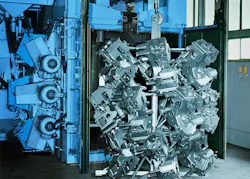
How do you know the configuration of your new shot-blast machine will treat parts exactly right and with absolute efficiency - before it’s even built? How do you know what tweaks are needed to your existing machine to perfectly treat a new casting?
How do you know if your current process parameters are delivering the best cleaning effect at minimal cost and effort?
The answer: by simulating the process and fine-tuning it before any changes are made to your set-up or specifications. Shot-blast simulation is a technique that’s been developed and refined at the Wheelabrator Technology & Test Center in Germany to optimize blast processes around the world - and, increasingly, in foundries.
Foundries use a broad range of shot-blast processes, with machine types ranging from batch tumblast to robot gripper. A shot-blast process involves countless variables - from the arrangement and power of blast wheels or air-blast nozzles to the way castings are loaded, handled, and exposed to the abrasive. Add to these the numerous settings involved with blasting cycle times and batch sizes. There’s more than one way to blast a part.
Finding the single, optimal way to shot blast castings has never been more important. Over- or under-blasting costs money modern foundries cannot afford to lose. At the same time, increasing casting complexity, more frequent product changes and impatient go-to-market plans for new products mean trial and error simply won’t do. Shot-blast processes need to be validated and fine-tuned fast and accurately. That’s where blast simulation comes into play.
What is blast simulation?
Blast simulation is a way of showing the coverage and intensity of any given blast process on a specific part or casting. Based on the 3D CAD files of the part that’s to be treated, it simulates the impact of the abrasive on the surface for different process configurations and parameters, including how parts are arranged on hangers or other modes of workpiece transport.
The blast effect is then shown as a heatmap with “hot” areas indicating more intensive coverage and “cooler” areas the opposite.
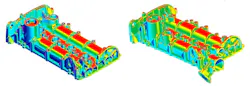
It’s a simple and effective way to very quickly try multiple process variations, zero in on the most effective ones, and optimize them further. This can happen anytime but, crucially, long before the new process is built or needed. The part does not even have to exist yet, other than as a CAD file.
Blast simulation was first developed for automotive castings - engine blocks, in particular - where increasing complexity and the addition of deep internal channels meant early validation of the required blast process was crucial in specifying new production lines.
A key requirement for effective blast simulation is controlled, guided movement of the workpiece. This makes it ideally suited to applications such as wire mesh belt, robot gripper, hanger type, inclined belt, and monorail machines - solutions increasingly used in foundries to process more complex or delicate castings - where simulation can significantly improve both quality and process economics.
In contrast, tumblasting processes, where the position and movement of individual castings cannot be predicted or controlled, are not well suited for blast simulation.
Optimized blast coverage, reduced abrasive, and energy consumption and faster cycle times are all up for grabs - on top of a faster, evidence-based route to the best process. In the following, we show how that plays out in different scenarios.
Process validation for new equipment
An investment in new shotblasting equipment is a significant commitment. Blast simulation can ensure that the best solution is found quickly and optimized to deliver the best economics. It reduces risk without increasing cost - by speeding up the design process based on robust evidence.
In some cases, blast simulation accelerates go-to-market times not just by helping spin up new production lines faster, but by ensuring the casting itself is optimized for production. For example, it can be used to determine if an engine block design with complex internal surfaces can be effectively blast cleaned or peened at all. Here, the simulation can provide vital feedback before product design is locked down, and can trigger small design modifications that improve the effectiveness and efficiency of the shot-blast process.
New process, existing equipment
Modifying existing equipment to process new products is a common scenario in foundries. Blast simulation can run the new casting through the machine virtually well ahead of production start. It can show if and where changes might be required to settings, workpiece handling or even the machine.
Based on evidence from the simulations, foundries can weigh up options and make smart decisions. When is a major modification justified? What else would we gain from it? What’s possible with the existing set-up? What are the trade-offs? Do we really need additional blast wheels on the machine, or might the wheels already installed be positioned or angled differently? It’s easy to see how having ready access to answers to these questions can save real money.
Optimizing existing processes
Even when neither equipment nor product are due to change, blast simulation can validate the existing process and find potential to optimize. Perhaps nobody has ever questioned the standard operating procedures for a given machine and product. Perhaps batch size, cycle times, and the way castings are loaded onto hangers have been taken as set in stone for decades. What if there was a better way?
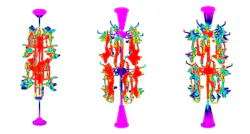
A recent project with a foundry customer illustrated what’s possible. The foundry team were loading six castings at a time on rotating hangers to run them through the machine. After simulating various new combinations of hanger movement and casting placement, a process was defined that allowed 10 instead of six castings to be treated simultaneously. That’s an extra 67% capacity, plus reduced energy, abrasive, and labor costs per part.
Thanks to blast simulation, this could be achieved through simple, cheap modifications to the workpiece support and movement. But even just validating cycle times to make sure a process does not over-blast parts can make a real difference to cost and capacity.
What’s next for blast simulation?
The team at the Wheelabrator Tech and Test Center continue to evolve and refine blast simulation technology to further improve its precision. Simulation results are routinely validated against results from tests with real parts on real machines, with findings fed back into the software to increase its capabilities.
Research is currently underway to better understand and map ricochet effects (secondary impacts of abrasive particles) and reflect them in the simulation.
Blast simulation can visualize blast coverage patterns on castings without a real machine or real part. It allows fast trialing of different machine designs, blast wheel/nozzle configurations, workpiece transport options and settings. Ultimately, to get to a better process faster or to validate and optimize existing processes.
About the Author
Christian Timmer
Head of Testing
Christian Timmer is the Head of Testing at Norican Group’s Wheelabrator Technology Center, Metelen, Germany.
Matt Schweitzer
Director of Sales, North America
Matt Schweitzer is the Director of Sales, North America, with Wheelabrator Group.