Automation Bridges the Recruitment Gap
Key Highlights
- Automation reduces manual tasks, making foundry work safer and more attractive to workers, and decreasing reliance on skilled labor.
- Fully automated molding lines and robotic filter setters increase production speed, quality, and cost efficiency with minimal human intervention.
- Automated grinding improves finishing consistency, reduces labor costs, and ends exposure to hazardous conditions.
- Implementing flexible, easy-to-program automation tools allows foundries to adapt quickly to changing production needs without extensive retraining.
- Adopting these technologies saves costs, improves product quality, and establishes a safer, cleaner workplace.
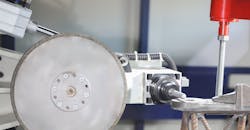
With an aging workforce that’s retiring rapidly, North American foundries face major hurdles in recruiting skilled operators: a shrinking pool of technically educated workers, strong competition from other sectors for engineers to technicians, and added to that, an image as dirty and dangerous places to work.
Of course, you can - and will have to - train new people, but with today’s attrition rates many operators will have left within six months or have moved to different roles.
A better option is to extend your automation. Cutting out as many manual tasks as possible shrinks the need for constant recruitment and makes work much safer and more attractive for seasoned and new operators alike.
Consider two automation options: filter setting and grinding.
Shift to truly automate your operation
The goal of a modern foundry is to consume the fewest possible labor resources without sacrificing performance. A fully automated, digitally controlled DISA green-sand molding line can meet that need. It requires only a single operator for production start and then can genuinely run with the lights off - from changing patterns and optimizing line speed to pouring, cooling, sorting, and shakeout. Unless an unexpected stoppage occurs, the operator simply selects the next CIM pattern recipe, and the line does the rest, delivering gains in speed, quality, cost efficiency, and resource utilization.
Automatic pattern changes and core setting on the molding machine are central and extremely effective tools. While DISA’s Automatic Pattern Changer (APC) can change plates in as little as one minute, filters usually still require an operator to add them manually.
Automatic Filter Setter for DISAMATIC
The DISAMATIC Automatic Filter Setter is a PLC-controlled robot designed for DISAMATIC D3 vertical moulding machines that automatically inserts filters into un-cored molds, operating at up to 555 molds/hour, and improving production efficiency while maintaining machine cycle time.
Recruit the robots
Using the Automatic Filter Setter (AFS) robot to insert filters directly into the uncored molds fills the automation gap. Control of the robot’s movements and filter setting locations in the molds are fully integrated into the molding machine’s control system. The robot receives new filter setting locations automatically during pattern changes, without any manual intervention.
This will ensure the line can run at its full capacity without any delay from the Automatic Core Setter (CSE.) This combination is perfect for very fast molding machines like the DISAMATIC D3. Compared to using a CSE on its own, the AFS increases productivity by up to 15%.
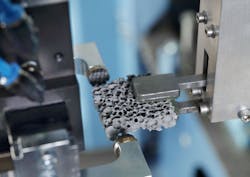
The AFS can be outfitted with a semi-automatic or fully automatic filter feeding unit that positions filters for the robot to pick up, and requires no special tooling or programming. As the AFS reduces wear on the core setter and needs no core masks or vacuum to hold filters, operating costs are cut further.
It’s also fully integrated with Monitizer | CIM’s automation tools and the molding line rather than being a third-party add-on. So, when the pattern (and the CIM recipe) changes, the operator doesn’t have to do anything; the robot receives new instructions for filter placement via the molding machine along with the rest of the line.
Improve throughput in the finishing room
When castings leave shakeout, automation typically stops and finishing work is handled manually. Manual grinding is labor intensive and may result in quality variation; the workers may be prone to injury depending on the operator’s experience.
“Grinding is hard work but finding employees to do it is even harder,” observed David DeValkenaere, managing director of Operations and Manufacturing for Castalloy Foundry. “The second challenge is that operators tend to overgrind.”
Fully enclosed, hands-off machine grinding means operators have far less (in fact, near-zero) exposure to vibration, metal chips, or airborne dust. This makes for cleaner, safer and more attractive work environments, eliminating eye injuries, body strains caused by lifting or awkward positioning, among other safety risks.
With one operator overseeing multiple machines and faster cycle times, productivity increases. The machine removes variability - thereby reducing defects and ensuring high finishing quality. “The machine does it exactly the same every time and consistency saves money,” DeValkenaere reported. “And it doesn’t get tired!”
Automated grinding that’s made for foundries
Automated grinding is not new and while some foundries have adopted it, acceptance has depended on application and workforce. Traditional grinding machines often require CNC programming skills and can be expensive, inflexible, and difficult to use. Lengthy setup and job changes don’t always align well with the unskilled or semi-skilled laborers common in many foundries today.
Most grinding machines require custom fixtures to hold each casting and be fabricated to tight tolerances, which increases costs when it’s time to tool up for a new contract. With the DISA GRIND, fabricating new fixtures is quick and cost-effective. In just a few hours, you can make a fixture using inexpensive components.
The DISA GRIND is straightforward to operate and program, and tackles multiple longstanding foundry problems: hazardous, dirty manual grinding that’s tough to recruit for, wasting expensive training on a fast-changing labor force, and inaccurate and inconsistent finishing.
Simple, flexible, productive auto grinding
The DISA GRIND is simple to operate using an intuitive, user-friendly touchscreen and handheld programming control box. This makes setup fast and straightforward and eliminates the need for CNC programming skills. With unlimited programs and program lines, the DISA GRIND also delivers exceptional flexibility.
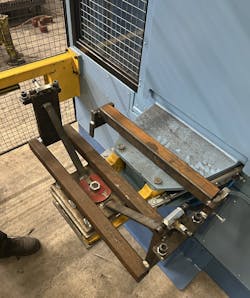
“The training was quick and easy,” according to the Castalloy manager. “In four hours, our operator was proficient in tracing a part to program the machine to grind it.”
This new generation of grinding machines is designed for operational flexibility. Programs can be adjusted on the fly, making it easy to grind a little more without stopping production. The system is ideal for foundries running short batches with frequent new castings, yet equally effective for long runs, especially with the pallet-loading option that increases throughput and further reduces labor needs.
Another benefit is with no foundations required, the DISA GRIND can be moved around with a forklift.
Immediate results from auto grinding
Castalloy found the DISA GRIND reduced its labor costs significantly. “One machine translates into a reduction of at least two people,” DeValkenaere said. “It also cut our PPE costs by an average $100 per week per person. We used far fewer gloves, aprons, respirators, sleeves, green jackets, and face shields.”
Lower material use (silica wheels, carbide deburrers) also reduced costs. As a result, Castalloy estimated savings of $10,000 annually per person because it does not have to constantly replace or maintain its many different types of finishing equipment and material.
Testing machines with your own castings is vital because rigidity and stability are important: some machines that can auto-grind aluminum and even steel may struggle with harder cast irons.
“At Castalloy, we pour 165 different grades of steel, stainless steel, mag steel, white iron, grey iron and ductile iron,” DeValkenaere noted. “Going from raw material to a finished machined casting not only saves days in scheduling, shipping and production, but the cost savings in operators allows our lean team to specialize and produce higher quality castings in less time. I would recommend DISA GRIND as a smart investment in people and equipment.”
About the Author
Sandy Calabrese
Director of Sales for DISA – North America
Sandy Calabrese is the Director of Sales for DISA North America, a Norican Group company.