Building a Sustainable Foundry Talent Pipeline
Key Highlights
- Olson Aluminum Castings uses structured internship and early-career programs to transfer decades of institutional knowledge from experienced foundrymen to new talent.
- Interns and engineers participate in rotations across all major operational areas, gaining practical skills and contributing to process improvements with documented outcomes.
- The programs foster safety, operational understanding, and leadership skills, preparing participants to influence and improve foundry operations effectively.
- The foundry emphasizes measuring outcomes through documentation, presentations, and tangible process improvements to ensure talent development aligns with operational goals.

Across the metalcasting industry the workforce challenge is frequently framed as a shortage of engineers or skilled labor. In practice, there is a deeper issue: the risk of losing decades of institutional knowledge as highly tenured foundrymen approach retirement. Process nuance, troubleshooting instincts, and practical judgment earned over years on the foundry floor are difficult to capture in documentation alone.
At Olson Aluminum Castings, this reality reshaped how we think about talent development.
Rockford, IL-based Olson Aluminum Castings is a green-sand and air-set molding foundry pouring aluminum for castings with superior machinability and surface finishes, for industrial customers.
Rather than viewing internships and early-career engineering programs as standalone pipelines, we have designed them as intentional knowledge-transfer systems, anchored by the experience and leadership of long-tenured foundrymen. The result is structured internship and early-career development programs that integrate technical learning, hands-on exposure, and leadership accountability, producing measurable benefits for both people and processes.
Development programs with operational intent
Instead of positioning internships as short-term labor or passive observation, Olson's Summer Internship Program is intentionally structured as a 500-hour, project-driven learning system over a minimum of 12 weeks. Interns are assigned full ownership of a casting project, from design feasibility through production, while rotating through each major operational area of the foundry, including coremaking, molding, melting, pouring, and finishing.
This serves two critical purposes. First, the program builds operational literacy. Interns gain firsthand understanding of how upstream decisions impact downstream results (defects, rework, throughput, and cost) by learning directly from Olson Aluminum Castings' 80 years producing high-quality aluminum castings, and from experienced foundrymen whose experience has shaped and refined those processes over generations.
Second, the program ensures process contribution. Each intern completes a defined improvement or analysis project focused on safety, quality, or efficiency, delivering documented outcomes that add immediate value to operations.
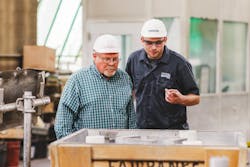
Interns complete the program with a formal presentation to executive leadership, reinforcing communication discipline and analytical storytelling, skills essential for effective engineering leadership.
Early-career engineering development
To maintain momentum beyond internships, Olson piloted a 12-week Production Engineer Development Program for newly hired engineers. This program formalizes the sort of training that often is left to informal mentoring by providing systematic exposure to every core foundry function, balancing hands-on immersion with structured process analysis and creating a clear, intentional trajectory toward executive leadership development.
Participants rotate through six operational areas, including core room, green-sand molding, air-set molding, melt room/shakeout, pattern shop, and cleaning operations. Each rotation emphasizes equipment operation and process controls; quality checkpoints and defect drivers; operator collaboration and knowledge transfer; and identification of "low-hanging fruit" improvements that enhance safety, ergonomics, or process stability.
Daily and weekly recap requirements reinforce disciplined observation and documentation, while mentorship from experienced team leaders ensures institutional knowledge is transferred, not lost.
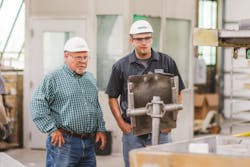
Kevin Gorman, a Production Engineer who completed the Production Engineer Development Program reflected on its impact: "Investing my time and effort across all aspects of the foundry helped me bridge the gap between the engineering and metalcasting theory learned in school and real-world design for manufacturability and production, a transition that can be difficult for young engineers early in their careers."
Benefits beyond talent retention
While these programs were designed to develop personal experience, the operational benefits have been equally compelling.
- Improved cross-functional alignment. Engineers who understand the realities of core production limitations, sand variability, melt scheduling, and finishing constraints make better design and scheduling decisions. This reduces friction between engineering, operations, and quality teams.
- Earlier identification of process risks. Structured rotations expose engineers to variability drivers that often are invisible from behind a desk. Intern and engineer observations have led to refinements to process sheets, tooling storage, and production sequencing.
- Stronger safety culture. Embedding safety expectations early, rather than retrofitting them later, reinforces safe behaviors as a non-negotiable foundation of operational excellence, consistent with Olson's "Safety First, Always Forward" core value philosophy.
- Leadership readiness. Perhaps most important, participants begin developing leadership capability earlier in their careers. By presenting findings, defending recommendations, and working alongside operators, they learn to influence through credibility rather than title.
Lessons for other foundries
Several principles from Olson's experience are broadly applicable across the industry.
Design talent development like a process. Clear objectives, defined deliverables, and structured feedback loops matter. Just as foundries wouldn't run production without process controls, talent development requires the same discipline.
Integrate operations and learning. Hands-on exposure accelerates understanding far faster than classroom instruction alone. The foundry floor is the most effective classroom for developing operational instincts.
Treat knowledge transfer as strategic. Experienced operators are invaluable educators when given structure and support. Their expertise represents decades of problem-solving that can't be replaced by manuals or training videos alone.
Measure outcomes. Require documentation, presentations, and tangible improvements, not just participation. This transforms development programs from feel-good initiatives into strategic investments with trackable returns.
These programs do not require large teams or excessive capital investment. They require intentionality, leadership commitment, and alignment with operational priorities.
"The knowledge transfer between generations is critical not only to our organization but to the long-term future of the foundry industry as a whole. This is not the easy option, but it's the essential one," foundry president Tad Olson emphasized.
One engineer at a time
As the metalcasting industry evolves, the foundries that thrive will be those that invest not only in equipment and automation, but also in people capable of optimizing and leading those systems. Structured internship and early-career development programs offer a practical, scalable way to build that capability, strengthening today's operations while securing tomorrow's leadership.
At Olson Aluminum Castings, workforce development has become a core component of operational strategy. The result is a growing pipeline of engineers and leaders who understand the foundry from the floor up and are prepared to carry the industry forward.
About the Author
Shane Pulgarin
Human Resources Director
Shane Pulgarin is the Human Resources Director - Strategic Operations & Workforce Development at Olson Aluminum Castings, Rockford, IL.