Measuring the Costs of Compressed-Air Leaks
Key Highlights
- Compressed-air leaks can waste 20-30% of generated air, leading to substantial financial losses and increased energy costs.
- Traditional ultrasonic leak detection provides a snapshot but may miss ongoing or developing leaks; pressure-based assessments offer a comprehensive view of total system losses.
- Monitoring pressure variations in real-time helps identify pressure drops and instability, preventing costly over-pressurization and equipment wear.
- Automated tools Air Aware are able to present cost-effective, continuous leak detection and pressure monitoring, supporting proactive maintenance strategies.
- Understanding and managing compressed-air leaks is crucial for reducing operational costs, extending equipment lifespan, and maintaining product quality.
Compressed air is among the most expensive utilities used in manufacturing facilities, and yet costly air leaks often go undetected for weeks, months or even years. Compressed air is interesting because it is used in more than two-thirds of all U.S. manufacturing plants, may account for more than 10% of a facility’s electricity expenses, and compressed-air systems often leak 20-30% of the compressed air created by the air compressors.
According to the U.S. Dept. of Energy guidance, a truly well-maintained compressed-air distribution system may only leak about 10% of its output. In our past work with U.S.-based foundries, a more common finding was that 20-40% of the air compressor output was lost to filling leaks. In some of these studies, we found that compressed-air leaks can translate into substantial financial losses, sometimes in the range of $15,000 to $50,000 annual losses just due to additional electricity costs.
For 27 years Sensor Synergy has helped U.S. manufacturers better utilize information provided by electronic sensors, especially when different types of sensors are combined to create new insights into manufacturing processes. After working in foundries with several manufacturers on issues associated with compressed-air leakage and compressed-air pressure variations (droop or sag), we have focused on helping manufacturers to understand losses in their plant’s compressed-air system in a do-it-yourself, cost-effective manner.
Compressed-air leaks are difficult to identify, and it is even more difficult to understand the magnitude of the loss for each identified leak. When compressed-air leaks somewhere in a foundry’s compressed-air distribution system, there are few physical signs – there is no puddle of water or hydraulic fluid, the sounds from a leak are often masked by other noises in a plant, and most people cannot detect the air flow from a leak unless they already know the leak location and move their hands to within a few inches of the leak. And leaks can occur anywhere, but often at a link to connected equipment.
In addition to the obvious problem that it is costly to waste compressed air, less apparent are the hidden costs. Extra cycling of the air compressors increase both operational costs (electricity) and maintenance costs. In some facilities, excess compressor capacity is acquired to compensate for the leakage losses; this translates into acquiring, operating and maintaining more compressor equipment than is needed.
Another hidden cost is the variation in air pressure at the machines that need compressed air to function. Droops, sags, spikes and other variations in air pressure can affect the quality of the product, especially in machines that depend on reliable, pressurized air for normal operations.
In addition, leaks can cause an overall drop in air pressure and an operator directed, increase in set-point pressure to compensate for leak-related pressure losses - a costly solution. A general rule of thumb for a compressor operating around 100 psi is that the electricity costs increase 1% for every 2 psi increase in operating pressure. And to make matters worse, the existing leaks in the system generally lose even more air as the system pressure goes up.
Leaks cause all components of the compressed-air system to cycle more often than necessary. These additional cycles, in some cases, 30% more cycles than necessary, shorten equipment lifetime. Other indirect effects include more frequent maintenance and more frequent unexpected downtime.
Usually, manufacturers rely on periodic inspections using handheld ultrasonic leak detector microphones to locate compressed-air leaks. While effective at finding some of the individual leaks, it is difficult to assess the magnitude of the leak with an ultrasonic microphone. The ultrasonic “loudness” of a compressed-air leak at a connection is strongly dependent on the specific shape of the whatever connector imperfection is causing the leak. It is possible for much air to be emitted from a large leak that is disproportionately quiet compared to a small but “noisy” leak.
These ultrasonic survey inspections provide a snapshot of some of the leaks at the time of the ultrasonic survey. Between inspections, new leaks can develop and existing leaks can become worse without anyone knowing. In addition, the ultrasonic leak detection surveys may not investigate all the places leaks occur.
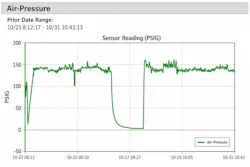
Another approach to understanding the overall compressed-air leakage at a plant is to make a “leak-down” assessment of the aggregate leaks using detailed, pressure vs. time measurements. This type of assessment can be made by carefully analyzing the pressure-vs.-time profile for the measured pressure in the system during charging and discharging of the compressed-air system. The discharge and charge cycles may occur on weekends or during compressed-air system maintenance, but this type of analysis can only occur when the normal compressed-air users are idle.
It should be noted that the most meaningful measurements during the discharge and charging cycles are made when the system’s air pressure is within 15 psi of its operating pressure.
This “leak-down” approach can provide a good approximation of the total leaks in the system, including pipes, connectors, air drops from header pipes along the ceiling, and receiver (storage) tanks. All compressed-air distribution hardware components can leak air and waste money; an overall assessment of the aggregate leakage helps plant stakeholders understand to a good approximation the magnitude of the compressed-air leakage problem.
If the size of the air compressor in horsepower is known, or the volume of air in cubic feet per minute delivered at the operating pressure, then this type of detailed analysis also can provide the cubic feet per minute loss due to leakage, the percent of the air compressor output used to “feed the leaks,” and the approximate monthly financial cost of the leakage.
In addition, during normal facility operations, the same measurement tools can be used to monitor air-pressure variations near the location of manufacturing equipment using compressed air.
Compressed-air pressure instability - sag, droop, and spike events - can silently and mysteriously affect production quality. If you measure the compressed-air pressure every second of every day at the location of most interest, you can measure pressure instability or simply air-pressure drop. With ongoing air-pressure monitoring measurements, you'll know if you have this problem and which branch of your compressed-air distribution piping suffers the most from sag. Some plants raise the compressor discharge pressure to compensate for pressure drop at production equipment during high-demand periods - a costly solution.
It is important to note that this “leak-down” approach will not find individual leaks. It will indicate how much air is being lost to leaks and when it is time to hire an air compressor service organization to find and fix the leaks. Also, this approach can be used in a before-and-after-repair measurement so that the overall effectiveness of the leak repair efforts can be assessed.
Tools like Sensor Synergy’s Air Aware product can provide the hardware and software to make all of these measurements in a cost-effective, automated manner, including weekly summary reports and text/email notifications to alert key stakeholders when out-of-normal measurements occur.
About the Author
James Wiczer
President
Jamie Wiczer is the founder and president of Sensor Synergy, a developer of Internet-based, industrial monitoring solutions for improving energy efficiency and productivity.