Batch Size Matters
Key Highlights
- Accurate batch weight measurement directly affect mold quality and green strength.
- Mechanical issues such as leaks, worn seals, and scale inaccuracies can cause batch size variability, impacting sand conditioning.
- Regular calibration and inspection of hopper scales, seals, and transfer points help maintain measurement accuracy and process stability.
- Monitoring batch size trends and power draw can reveal hidden losses or gains in the system.
- Understanding and controlling batch size ensures consistent energy application, uniform clay coating, and optimal mold performance.

Batch weight is the most significant measurement for calculated water and clay additions in an automated green-sand system. When batch size is not properly controlled or measured, even a stable sand system can drift, leading to extended downtimes, poor surface finish, scrap castings and additional maintenance costs.
Not a blender… an energy adder
A green sand muller is not a simple blender. Rather, it is helpful to think of it as a mechanical-energy input system. The interaction of wheels, plows, time, and load applies mechanical energy in a way that activates clay platelets, coats sand grains with clay, and distributes water uniformly.
A green sand system runs best with a defined volume of material. When the batch size deviates from target (or is reading incorrectly), the energy applied per-unit-mass changes. When a muller has more mass than reported, the full amount of energy needed may not be applied.
Sand grains may be left uncoated or unequally coated. At a fixed mull time, an overfilled batch will have less energy per ton of clay. Less energy may lead to lower clay activation, which could result in lower green strength, and ultimately a scrap casting.
Lower energy per ton also may result in poor compactability response, or large fluctuations in compactability. Alternatively, an underfilled muller can lead to overworking the sand and, potentially, break down the clay platelets, create fines, or drive off moisture. Whether overfilled, or underfilled, the sand might have the same properties as a properly sized load but behave differently. The water may be in the sand but not effectively activating the clay platelets. The sand distribution may not have changed, but the clay coating may not be evenly applied.
A foundry increased its batch size and lowered the mull time to meet increased production demands. To compensate for the larger batch size, they also increased the clay and water additions. In the lab, the moisture, MB Clay and compactability remained constant, but they saw a 3- to 4-point decrease in green strength and an increase in sand-related defects. Standard sand lab results may seem to be correct while the sand itself is not truly conditioned for molding.
Water and clay additions are based on batch size
With a compactability controller: Most foundries’ equipment automatically calculates the water addition. Additional clay controls can be added to automatically measure and determine clay addition for each sand batch. The calculation considers many variables, such as return sand temperature, return sand conductivity, compactability target, measured compactability, and green strength. However, the parameter with the most impact on automatic water and clay additions is batch weight. The calculation is based on the batch size measurement.
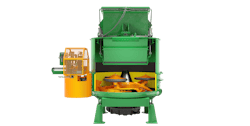
Without a compactability controller: Most foundries rely an automated controller with in-line testing, but even foundries without automated systems depend on consistent and accurate batch sizes. These foundries likely add water and clay based on a percentage of an assumed consistent batch weight. When the batch size is inconsistent or unknown, these additions also become inaccurate.
For example, a fixed volume of water added to a lighter-than-expected batch increases moisture more than intended. The same addition in an oversized batch may be insufficient to achieve proper compactability. Clay additions follow the same logic: Changing the sand amount alters the clay-to-sand ratio.
This leads to wider variations in properties, forcing molding operators to compensate with squeeze pressure or pattern-side fixes - none of which address the real issue.
The hidden batch size error: It is important to understand how the signals from the load cells translate into the batch weight reported by the control system. Regular checking and calibration on the batch hopper scales is essential. However, batch size accuracy is only as good as the system’s ability to contain what it measures. Leaks, worn seals, and degraded liners have the potential of allowing sand to escape after the batch has been weighed - or by allowing material to bypass the scale entirely.
If the batch hopper is leaking into the next batch, time between batches becomes a significant factor and the amount of water and clay additions may not be accurate for the actual load size.
When seals on muller doors, discharge gates, conveyors, or sand hoppers wear, material losses often occur gradually and intermittently. Because the control system still believes the full batch mass is present, water and clay additions are calculated for material weight that may no longer be correct.
Even small losses per batch compound quickly. A few pounds of sand leaking per cycle can shift moisture, clay percentage, and energy-per-ton enough to create measurable variation in compactability and green strength over a shift. These changes are often misattributed to clay quality, sand temperature, or testing error, when the root cause is mechanical.
Leaks upstream of the scale create the opposite problem. If sand bypasses the scale or builds up due to sticking or bridging, the reported batch weight may be artificially low or inconsistent. Then, the system under-adds water and clay, leading to stiff sand, poor mold fill, scabbing, or erosion-related defects.
Quick field checks
These checks can be performed during routine walk-throughs or while troubleshooting sand variation.
- Look for sand buildup near mullers, under conveyors, hoppers, and sand transfer points. Check for fresh piles that reappear after cleanup.
- Inspect muller door seals for wear, gaps, or hardening
- Calibrate batch hopper scaling system
- Chart and trend batch size and amps (power draw) – compare with historical norms
- Ensure batch size is within OEM specifications. Same for batch time. Listen, time, and compare to the OEM cycle chart.
- Verify discharge hopper seals fully and consistently
- Check air cylinders or actuators for full stroke and repeatability
- Watch for unexplained increases in water or clay demand or large compactability swings without corresponding lab changes
- Check hoppers and feed chutes for sand hang-up or buildup
- Inspect around water-addition points for leaks or dripping nozzles.
Batch-weight variation often shows up as “noise” in SPC charts. Engineers may chase trends in moisture, clay, or additives without realizing that the muller itself is introducing variability before the sand ever reaches the molding line.
Before chasing the next additive, sensor, or test method, it’s worth asking a simple question: Are we actually mixing the amount of sand we think we are? Getting the right answer can be the difference between a reactive sand system and a truly controlled one.
Learn more green sand molding principles and methods at www.simpsongroup.com
About the Author
Michelle Ring
Technical Services Manager, Ductile Iron Society
Michelle Ring is the technical director of the Ductile Iron Society. Contact her at LinkedIn.
Simpson Technologies
Learn more green sand molding principles and methods at www.simpsongroup.com