High-Value, High-Alloy Parts Produced Without Melting
Key Highlights
- Cold spray accelerates solid metal particles to form metallurgical bonds without melting, minimizing oxidation and thermal stresses.
- The technology is especially suited for refractory metals like tantalum and niobium, which are difficult to process via conventional melting methods.
- High deposition efficiency (>90%) reduces material waste, lowering costs for expensive alloys such as C-103.
- Cold spray allows for large, complex structures with fine wall thicknesses, ideal for aerospace and defense applications.
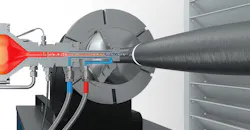
It’s critically important for metalcasters to stay current with emerging technologies, including alternative or potentially competitive technologies. Additive manufacturing is the most obvious example of this, and while laser-based powder fusion is the most prominent additive technology for manufacturing metal and metal-matrix composite parts, “cold gas spraying” is becoming another important alternative.
Also called “cold spray,” cold gas spraying offers new possibilities for forming large components, complex material combinations, and refractory metals.
A pioneer in cold spray is Impact Innovations GmbH, which recently struck a collaboration with Taniobis, whose business is converting metal ores and secondary materials into high-performance tantalum and niobium-based powders. Impact Innovations is striving to establish cold spray technology as a competitive option for surface coating and additive manufacturing.
No melting, no oxidation
In the cold spray process, a carrier gas accelerates metal powder particles to supersonic speeds and propels them onto a surface while they remain in the solid state. Thanks to their kinetic energy, the particles form a metallurgical bond without melting the material.
This approach offers several advantages over melting-based manufacturing processes. Because the material never melts, oxidation is minimized, the original microstructure is largely preserved, and thermal stresses that can lead to distortion or cracking are avoided.
Cold spray’s high deposition rates produces dense, low-porosity components. And its capable of combining dissimilar materials, making gradient structures, multi-material components, and localized coatings possible.
Another advantage is scalability. Unlike many powder bed processes, cold spray can produce large structures, so it’s attractive for applications like rocket and jet engine components.
Materials and process collaborate
The full potential of cold spray processing requires the powders to have carefully controlled properties. The technology is particularly well suited for refractory metals (like tantalum and niobium) with melting points above 3,000°C. These materials resist corrosion and high temperatures but are difficult to process by conventional melting.
Cold spray deposits material without melting it, so challenging materials can be processed reliably without requiring a protective atmosphere.
Material efficiency is a further advantage. Because over 90% of the powder can be deposited onto the component, the buy-to-fly ratio (the volume starting material required to produce the part) approaches one. This greatly reduces material waste and lowers production costs, particularly for expensive alloys such as C-103, a high-performance refractory metal alloy of niobium (Nb), hafnium (Hf), and titanium (Ti.)
Cold spray also provides greater design flexibility. Wall thicknesses as low as 0.5 mm can be achieved, for lightweight structures that retain excellent mechanical strength.
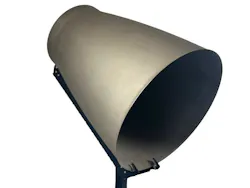
Together, cold spray and refractory metal alloys such as tantalum and niobium offer a practical solution for manufacturing components that combine high mechanical performance with cost-effective production.
"C-103 is subject to strict export controls," explained Jan Kodas, R&D Engineer at Impact Innovations. "Working with Taniobis … has allowed us to secure reliable material availability while maintaining a stable production process."
The combination of Impact Innovations' cold spray technology and Taniobis powders makes it possible to manufacture components with well-defined material properties and high reproducibility.
Over 90% material utilization
Testing with a sample component has demonstrated the performance of Impact Innovations' advanced modular EvoCSII cold spray process. Using Taniobis powders, deposition efficiencies exceeding 90% were achieved - an exceptionally high value compared with many other additive manufacturing processes. The results demonstrate that C-103 can be processed efficiently while producing high-quality components with the EvoCSII system.
"Our collaboration demonstrates how critical powder quality is to the performance of cold spray," according to Kodas. "Using Taniobis materials, we achieved outstanding deposition efficiency with our EvoCSII system and confirmed the technology's suitability for demanding high-temperature applications."
Next gen manufacturing
The combination of Impact Innovations' EvoCSII technology and Taniobis powders demonstrates how large, complex structures can be manufactured without many of the limitations associated with conventional forming and welding. The technology offers significant advantages for aerospace, defense, and energy industries, for example, and it allows both selective coating and repair of existing components, and additive manufacturing of new parts.