Switching Made Sense for One Ferrous Foundry
Key Highlights
- Induction furnaces can reduce direct emissions by over 75%, lowering environmental impact compared to cupola melting.
- Operators can make more precise chemical adjustments, improving metallurgical quality and reducing casting defects.
- Energy efficiency is higher in induction melting (70-85%) versus cupola melting (30-50%), leading to lower operating costs despite electricity expenses.
- The technology minimizes dust, smoke, and noise pollution, enhancing workplace conditions and safety.
- In one real-world example, a ferrous foundry cut CO₂ emissions by 330 metric tons annually and cut energy consumption in half.
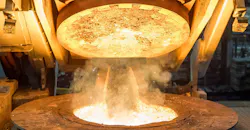
There are regulatory pressures on some foundries to switch replace their cupola melting operations with induction furnaces, but there are also other compelling reasons they may make that decision. According to its proponents, an induction furnace may reduce direct emissions of 75% or more compared to a cupola it would replace, minimizing not only off-gasses but also smoke and furnace dust.
Reduced noise pollution is another benefit, according to induction melting .advocates.
For those foundries aiming to improve metallurgical quality, induction furnaces will allow much more precise chemical adjustments, which is an advantage in producing higher-quality ductile iron or other specific alloy castings. Induction melting does not depend on coke combustion, which avoids the sulfur and phosphorus pick-up associated with cupola melting, contributing to cleaner metal and fewer casting defects.
Induction melting also allows foundries to use electromagnetic stirring to achieve more homogeneous melts and uniform temperatures, which adds to casting quality and foundry productivity.
Energy factors in
The electric melting option also achieves higher energy efficiency than cupola melting (70-85% efficiency, contrasted with 30-50% efficiency), with lower operating costs despite the expense of electricity. Those costs are offset by the savings from coke and reduced metal loss due to oxidation.
And the advocates also contend that induction melting improves foundries’ operational flexibility, with faster starting and stopping, and simpler alloy change-over.
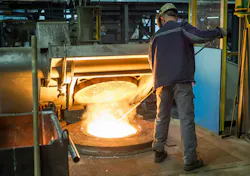
One foundry that has made the switch is Eisengiesserei Th. Schultz GmbH, a producer of gray and ductile iron castings for mechanical engineering and other product markets, in Warendorf, Germany. Last year Otto Junker GmbH commissioned a medium-frequency coreless induction furnace, converting the operation to electric melting in pursuit of decarbonization and an increased energy efficiency.
“The conversion to induction was a logical step for us on our way towards CO₂ neutrality,” reported foundry general manager Klaus Schultz. “The plant runs reliably, and we see significant efficiency gains in everyday operation.”
With a power factor of 1,200 kW and a volume of 1,700 kg of cast iron, the Otto Junker Monomelt furnace lowers CO₂ emissions from melting by approximately 330 metric tons per year, according to the developer. Along with precision process control, the Monomelt system stable power control that can be integrated into existing energy structures.
Integrated heat recovery
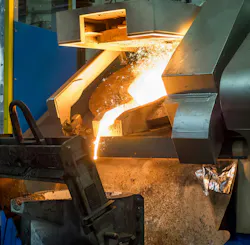
A central element is the glycol-free air/water recooler with integrated heat recovery that uses the heat produced during the cooling process to return energy to downstream processes, promoting overall foundry efficiency of the business. This reduces energy consumption, avoids additional operating resources, and lowers maintenance requirements, according to Otto Junker.
The OCP+ temperature monitoring system was installed to continuously detect coil and crucible temperatures, promoting a high operating safety for the foundry workers. Because Monomelt is a modular system, the equipment was adapted to the space available and energy provisions at the Eisengießerei Th. Schultz foundry.
“The project shows how conventional foundry processes can be made sustainable with state-of-the-art technology – and still be economical,” stated Otto Junker regional sales manager Andreas von Wachtendonk.
First year experience
The conversion project was announced in 2024 and now-induction-melting foundry started running at full capacity in February 2025. Compared to the previous cupola melting operation, energy consumption has been reduced by about 50%, with increasing process stability and more homogeneous melting results.
The operators also report that workplace comfort has been significantly improved because dust and noise emissions have been reduced, which the furnace developer emphasize is a considerable factor for medium-sized foundries striving to improve workplace conditions.