Innovation, Reliability, and Performance in Matchplate Molding
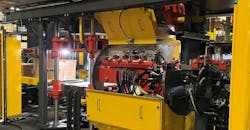
Matchplate molding and mold handling system designs continue to develop, and EMI has participated in that evolution by focusing on solving complex engineering challenges with solutions that can be customized to meet specific production and safety goals.
EMI is active in this effort thanks to ongoing collaboration with foundries. By working with many well-maintained operations, we have gathered valuable feedback on the features and capabilities most important to matchplate molding applications. Much of this continuous improvement involves listening to the experienced teams at those foundries.
As matchplate molding operations have evolved over the years, EMI has focused on solving complex engineering challenges with solutions that can be customized to meet specific production and safety goals.
Building on their feedback, EMI’s engineers recently redesigned the 2024 matchplate molding machine to address present-day manufacturing challenges, while maintaining high mold-quality standards and increasing foundry capacities. The updated design incorporates a heavy-duty automated system with a simplified layout, helping to minimize maintenance requirements and reduce downtime.
Foundries have emphasized the importance of easier system maintenance, reducing sand abrasion and buildup, improving hydraulic mold-closing systems, providing easily replaceable wear parts, enhancing mold quality, and monitoring precise movement in both cope and drag positions.
Design updates
These are improvements implemented to help foundries achieve their production goals.
- Hardened chrome guide rods with replaceable Pacific bearings that require no lubrication
- Fixed roller bars for stripping off the drag flask and mold.
- LVDTs for both cope and drag positions.
- Heavy-duty cope strip cylinders, providing additional head room for core setting.
- Rotary actuator design for the roll over with mid position for operator interface with the drag flask, if required.
- Vee-shaped hardened roll-over ring sitting atop Vee rollers, to eliminate sand abrasion.
- New, fork-type bottom board delivery system to ensure even and accurate board placement in the drag every time.
- External bottom board cassette storage to minimize the number of boards to lift.
- Pressure-compensating hydraulic closing system with drag and cope cylinders to assure a positive controllable closing force, continuous closed molds during the strip of the mold halves from the flasks.
- Dual bearing support for VFD- controlled aerator shafts for durability and ease of replacement.
- Dual rotary measuring hopper louvers to provide optimal sand filling across the flasks.
- Newly designed cope-squeeze head with built in tuck strips for better mold quality.
Mold handling system
The foundry-specific mold handling system can operate with any type of matchplate machine and features a solid, heavy-duty design that minimizes sand buildup and significantly reduces the time and cost associated with nuisance sand cleanup.
The pallet cars are cast components - not fabrications - and are equipped with replaceable graphite tops. They feature universal shafts and rollers that are bolted from the shaft ends, rather than cantilevered. The weights and jackets are also precision-machined castings, incorporating venting slots and movable top weights to accommodate different sprue locations. The pallet cars travel on heavy-duty railroad rails, which are also used across all horizontal-transfer ancillary units, including weight-and-jacket transfer systems and plow-offs.
The weights and jackets are transferred using tapered clamps that center each component accurately, along with floating links that allow them to be set smoothly onto awaiting molds. Extended pins and reverse-tapered holes in the pallet car tops prevent movement when the weights and jackets are set without molds. Weight- and jacket-cleaning stations are available too, allowing the components to be separated and cleaned independently.
The mold plow-off is not simply a blade but a fully enclosed box with a trailing wiper scraper. This design ensures that molds carried on double pallet cars remain fully contained as they move into adjacent positions. Wings added to the far side of the pallet cars help contain sand breakdown after the weight and jacket are removed, reducing excessive sand spillage throughout the day and minimizing cleanup requirements.
All handling units use hardened rails and heavy-duty rollers rather than welded angle iron. Transfer is accomplished using proportional cylinders or precision VFD-driven motors and gearboxes, eliminating the inconsistencies associated with chain-driven carriages. Vertical movement is guided by hardened guide rods and non-lubricated bearings to support long-term, smooth operation.
End-of-the-line transfer cars equipped with the same rail system ensure smooth transitions throughout the line. Pallet car alignment is maintained by large-diameter guide rollers, keeping the system precisely on track as it moves between the pouring and cooling lines.
The future of matchplate molding relies on continuous innovation, reliability, and performance. The 2024 Matchplate Molding Machine delivers on all three, and EMI remains committed to helping foundries achieve their operational goals.