Key Highlights
- Dense-phase pneumatic systems are preferred in foundries due to their lower velocity, reduced wear, and minimized sand degradation.
- Regular inspection of wear parts, seals, and air springs is critical for maintaining system integrity and preventing failures.
- Proper pipeline layout, tight connections, and support are essential to avoid leaks, vibration, and movement that can impair system performance.
- Monitoring key variables like sand feed rate, air pressure, and moisture content helps prevent unintentional mode shifts and operational issues.
- Troubleshooting involves checking for leaks, blockages, faulty sensors, and incorrect settings to ensure continuous and efficient sand conveyance.
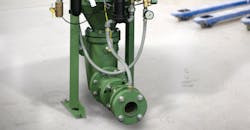
Without a doubt, minimizing maintenance costs is almost always a top priority when planning new foundry equipment investments. Because maintenance is an integral function of any piece of equipment, the foundry engineer can significantly influence and even predict these costs during the selection process. The more that is understood about how a system operates - and the factors that affect its performance - before the purchase decision is made, the better the chances of controlling future maintenance expenses and avoiding production losses. This is especially true for pneumatic conveying systems used to transfer sand in a foundry. These systems are often tucked away in a corner or basement of the plant, receiving attention only when operation has already stopped.
Pneumatic conveying systems generally can be assigned to two broad categories: dilute-phase and dense-phase conveying. Dilute-phase conveying operates under vacuum or low-pressure air - typically up to 20 psig - with pipeline velocities of 4,000 FPM or higher.
Dense-phase conveying uses medium-pressure air of 10 to 90 psig and pipeline velocities in the range of 450-2,500 FPM.
The concepts of dilute and dense-phase conveying date back more than 130 years. However, what works well in one industry does not necessarily apply to another. In foundry sand handling, dilute- and dense-phase systems often have been copied directly from other industries, even though experience has shown that they are not always the best solutions.
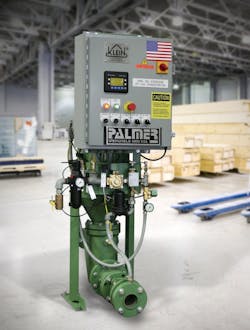
The terms “dilute” and “dense” refer to the material-to-air ratio (loading ratio) in the conveying line. In a dilute-phase system, the loading ratio is typically only 0.06 to 0.3 pounds of material per cubic foot of air. High-velocity air is required to entrain the particles, bouncing them along the pipeline as they remain suspended. It’s essentially a hurricane inside a pipe - and only powders and relatively “soft” materials can withstand such treatment. Dilute-phase conveying is definitely not a good choice for moving sand pneumatically.
Most dense-phase systems have a higher loading ratio - typically around 0.3 to 1 pound of material per cubic foot of air - and many require air boosters to maintain transport. However, this added air increases the total air volume in the pipeline, which raises velocity and leads to additional sand degradation. Transporting sand under these conditions can cause significant abrasion, shifting the effective screen size by several points and causing premature wear of the conveying pipe.
While dilute- and dense-phase systems with higher material velocities can be effective for “soft” materials such as powders and fines - materials that can tolerate being fluidized and accelerated without damage - foundry sand is far less forgiving. For sand handling, high-velocity, fluidizing systems should be considered only as a last resort, and only when no other economically feasible option exists and sand degradation can be tolerated.
To take full advantage of the factors that make pneumatic conveying of dry sand both efficient and economical, a dense-phase system operating at the lowest practical velocity but at higher pressures is generally preferred. The much lower conveying velocity dramatically reduces pipeline wear, virtually eliminates sand degradation, and drives operating and maintenance costs down. For these reasons, dense-phase systems have become the preferred choice in foundries.
Even the best dense-phase system will meet its design performance only when it is correctly installed and periodically monitored. Because the key variables in any pneumatic sand conveying system - sand feed rate, air pressure, and air volume - directly affect conveying mode, it is entirely possible to convert a dense-phase system into a dilute-phase system, unintentionally and with all the associated drawbacks, by simply ignoring the correct settings.
Maintenance & Operating Tips
Part of the system analysis should always include a particle size distribution check of the sand. If the sand contains excessive fines or dust, air conveying may not be a viable option at all. The sand must be dry and free-flowing, and if debris are present, a screen should be installed upstream of the blow tank. System capacity is also influenced by moisture content: the higher the moisture, the lower the flowability and conveying capacity.
When transporting sand to the core room, the conveying air must be completely moisture-free. Any external moisture can interfere with binder systems that are incompatible with humidity, resulting in scrap cores.
Recommended Inspection &
Maintenance Procedures
1.Inspect all wear parts regularly.
All components in contact with sand must be checked on a routine basis and replaced as needed to prevent damage.
2. Set maintenance intervals based on transporter usage.
A batch counter should be included in the control panel to track cycles and ensure timely maintenance. As a guideline, the following parts should be inspected at intervals of approximately 40,000 cycles: main seal, inlet cone, vent cone, vent cap, discharge flap, seal ring, and leaf spring. (Note: different designs may include additional or alternative wear parts.)
3. Ensure the transporter is fully depressurized before inspection.
Before inspecting any wear parts, turn off, lock out, and drain all air pressure from the transporter.
4. Monitor main seal wear during normal operation.
The main seal of the blow tank will wear over time and must be checked periodically for cracks or deterioration. This can typically be done by observing the inlet cone through the inlet housing sight glass. During a transporter cycle, look for air escaping around the main seal. If the unit does not have a sight glass, the valve must be disassembled and inspected manually.
5. Inspect the air spring for leaks and proper operation.
Inflate the air spring and check for leaks; replace it if any leakage is detected. If the air spring hesitates or fails to complete its stroke, inspect the associated air controls for external damage. If the system uses a different mechanism in place of an air spring, inspect that device for proper operation.
During startup, air flow should be set to the minimum required to maintain stable operation. Excessive airflow in a dense-phase system can cause as much damage as a dilute-phase system. Turning up the airflow does not guarantee higher throughput, in fact, it can produce the opposite effect, creating strong shock waves in the pipeline, damaging pipe supports, increasing pipe wear, and degrading the sand.
Finally, all pipe connections must be tight and pressure-tested. Leaks at pipe joints alter system design conditions and can reduce or even completely stop sand flow.
When properly designed, the length and diameter of the pipeline are matched to the required system performance. Therefore, if a system is designed to convey 10 tons per hour over 250 feet, extending the pipeline to 300 feet will reduce capacity accordingly.
Pipe runs should be laid out with the fewest bends possible; pipe bends and risers near the end of the line should be avoided. The entire pipeline must be rigidly anchored and supported so that it cannot sway or move during operation. Rod-type pipe hangers should not be used. Unlike air, gas, or water pipelines, sand pipelines are subjected to impact loads from sand slugs, which cause vibration and movement unless the line is properly secured.
All pipe sections and bends should be connected using special flanged joints. Butt-welding pipe sections in place of flanged connections should be avoided, as weld beads protruding inside the pipe create localized wear points and lead to rapid leakage.
Once a new system has been placed into operation and is running correctly, it is essential to record all operating parameters. If problems occur later, this data will allow you to cross-check performance and make the necessary system adjustments.
Pneumatic conveying, when chosen and operated correctly can have a profound impact on sand handling in your foundry. The correct choice can eliminate or reduce potential problems with dust collection, excessive fines, and maintenance. Therefore, investing some time and effort to evaluate key factors of the various options will result in better decisions and fewer headaches down the road.
Troubleshooting Guide
1. Receiving bin not being filled when empty.
Possible Causes:
- Transporter is not ON
- Transporter is in fault condition
- PLC is not in run mode
- Bin level probe defective
- Level probe cable damaged
- Level probe out of calibration
- Pinch valve not opening (in multi-bin systems)
- Bin fill selector switch is in the off position (in multi-bin systems)
2. Sand fill time too long.
Possible Causes:
- Fill time timer needs to be adjusted
- Wet sand
- No sand in supply bin
- Sand inlet blocked
- Vessel not vented
- Open/Close inlet valve solenoid not working
- Quick exhaust valve not open
3. Transport time too long.
Possible Causes:
- Insufficient air pressure
- Inlet cone not closed
- Vent cone not closed
- Air spring not inflated
- Leaking main seal
- Leaking vent seal
- Discharge flap proximity switch defective
- Air flow control valve not adjusted properly
- Discharge flap leaf spring broken
- Leaks in transport pipe
- Transport pipe blocked
- Excessive dust in sand
- Receiving bin level probe not reading full
- Pinch valve not open
- More than one pinch valve open (in multi-bin systems)
4. Transport cycle ends prematurely.
Possible Causes:
- High blow time alarm set too low
- Discharge flap proximity switch defective
- Blow tank pressure on solenoid not open
- Main air valve solenoid not open
5. Transporter delivers product to more than one bin during a single blow (for multi-bin systems.)
Possible Causes:
- No air pressure at fill valve
- Air pressure at fill valve set to low
- Fill valve solenoid spool is in vent position
- Damaged fill valve sleeve (replace)
About the Author
Jim Gauldin
Chief Sales Engineer
Jim Gauldin is the president of Palmer Manufacturing & Supply. Contact him at [email protected], or visit www.palmermfg.com