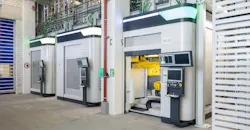
Additive manufacturing of sand cores has been understood in its basic functionality since the 1990s, and it allows for a considerable increase in the complexity and functional integration of castings. Market development has shown that additive - or 3D printing - processes offer significant advantages as a future technology for the foundry industry. The ability to adapt to flexible and specific requirements, reduce production complexity, and eliminate tool management and wear, make AM technology particularly attractive for foundries. And for buyers of castings, 3DP also opens possibilities for innovative geometries that cannot be realized with traditional methods.
It was these factors that motivated Laempe engineers to rethink 3D printing from the ground up and develop it independently of existing industry solutions. For over six decades, Laempe has specialized in coremaking technology for foundries, and supplying core-shooters to produce sand cores for metalcasting. It also develops and supplies sand mixers and process automation, and 3D printers.
Laempe introduced its additive manufacturing technology in late 2024 with an installation at BMW Group in Landshut, Germany, and it has been adopted by other manufacturers for printing sand molds and cores.
Whereas mold and core production with additive manufacturing processes has, until now, been relatively slow and expensive compared to the conventional technologies, the new LAEMPE L3D-200 sand printing system offers significantly increased build rates and fully automated options for core post-processing up to ready-to-cast cores.
On one hand, this new system will foster economically attractive opportunities for foundries to execute casting geometries that can no longer be produced using tooling in large-scale production; on the other hand, by eliminating the requirement for core and pattern tooling, 3D printing will be attractive for small and medium-sized production runs in jobbing foundries. The focus is on complex requirements such as production speed, degree of automation, binder processes, and overall process robustness.
Technological challenges, such as high production rates and parallel process flows, are identified in the concept phase and addressed through innovative solutions to achieve optimal results with modular and scalable machines.
By combining 3D printing with traditional core shooting processes, Laempe maximizes the flexibility for foundries’ manufacturing programs. They are able to choose between additive or conventional processes depending on their needs. This “hybrid” core production approach allows foundries to accomplish not only cost-effective production but also adaptability to changing market requirements.