Setting the Terms for Sand Reclamation
Key Highlights
- Mechanical sand reclamation at one U.K. foundry recovers approximately 5,000 metric tons of sand annually, reducing reliance on new sand and landfill waste.
- Reclamation removes binders, additives, and fines, restoring sand quality for reuse in molds and cores, and improving casting consistency.
- Hybrid systems combine mechanical and thermal methods to optimize energy use and maximize sand recovery efficiency.
- Digital sensors allow real-time monitoring of grain fineness, moisture, and other parameters, ensuring high-quality mold production.
- Implementing sand reclamation enhances environmental compliance, lowers operational costs, and improves worker health by reducing silica dust exposure.
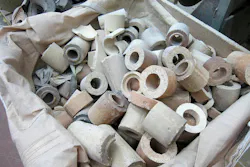
The MAT Foundry Group casting operation in Poole, England, implemented its mechanical sand reclamation system in 2022, with a secondary attrition unit recovering the spent material. Now, rather than shipping degraded green sand and core sand to landfill, the sand is mechanically scrubbed and cleaned so it can be reused in new molds and cores. MAT Foundry has estimated that the process can reduce new sand consumption by approximately 5,000 metric tons annually. It’s a practical example of a change in manufacturing methods brought on foundries by regulatory changes, but also operating costs.
In fact, sand reclamation has become a priority affecting plant design and machinery selection, specifically core and moldmaking systems and rotary and vibratory shakeout machines.
The problems with spent foundry sand involve the residual binders, additives, and trace heavy metals absorbed during the metalcasting process. These impurities may cause environmental leaching, material corrosion, and structural weaknesses when the sand is recycled.
But there is greater problem with foundry sand: airborne crystalline silica from molding and cleaning castings creates severe health hazards and operational problems. Workers inhaling fine silica dust generated by crushing and handling of sand risk permanent respiratory scarring and lung cancer.
Sand accumulating on surfaces and in moving components of machinery will also damage equipment and degrade casting quality.
The principle of reclamation is simple. During repeated casting cycles, foundry sand becomes contaminated with binder residues, carbon deposits, and fine dust created by thermal stress. This reduces mold strength, permeability, and dimensional consistency. Sand reclamation systems remove residual binders and separate the fines, which restores much of the original grain quality and makes it feasible for the sand to reused. That step also avoids the transport and landfilling charges.
MAT Foundry adopted a mechanical attrition system (aka, dry reclamation) which applies kinetic energy to break up large sand clusters into individual grains, and then remove clay or resin from the sand particles. This approach is effective for mid-sized foundries because it is less expensive to install and operate than thermal reclamation processes.
If the installation and operating costs are justifiable, foundries using chemically bonded sands, such as furan or alkaline phenolic systems, may consider thermal reclamation. These systems burn residual binder from the sand grains to achieve greater recuperation efficiency and cleaner grains. These are energy-intensive systems, but they can recover up to 90–95% of usable sand for reuse.
Hybrid sand reclamation is yet another functional possibility. This involves mechanical reclamation for most of the spent sand volume, with smaller thermal units processing only critical core sand streams. This reduces energy consumption while maintaining quality standards for precision castings.
Reclamation systems also create opportunities for digital process control. Sensors can monitor grain fineness, moisture, loss on ignition, and clay content in real time, enabling tighter control of mold quality and reducing casting defects.
The cost savings of sand reclamation have to be determined case by case, but sand reclamation clearly improves foundries’ environmental compliance. Landfill charges, transport costs, and sustainability reporting requirements are other parameters that will be improved.