Modeling the Induction Hardening Process
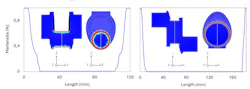
Steel crankshafts are typically treated by quenching and tempering after product forming, to establish a high-hardness (martensite) layer that will resist extreme fatigue, friction, and wear on the journals and fillets. This martensite layer is imparted induction hardening, which increases material strength and durability, and prevents premature failure under heavy rotational engine loads.
Controlling the induction hardening process to optimize the martensite layer depth of a crankshaft has been an area of study by the U.K.’s Advanced Forming Research Centre (AFRC), where metal forming is a focus of inquiry and industrial development.
The AFRC is associated with the University of Strathclyde and part of the National Manufacturing Institute Scotland. Working with Transvalor S.A. (a developer of virtual manufacturing software) and closed-die forger Bifrangi, the AFRC has demonstrated the effective use of FORGE® simulation software in simulating induction heating and hardening processes.
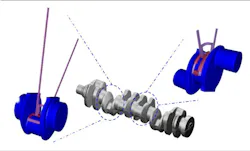
The hardening process involves heating the crankshaft to 850-1,000°C to create an austenite phase in the steel structure, then rapidly cooling it in water or oil or polymer solution that results in the martensite layer forming on the crankshaft surface. Often, this hardening is selective, using induction heating, so that critical surfaces of the crankshaft are martensitic and the rest remains tougher and less brittle.
As explained by Transvalor, the difficulty in simulating induction hardening involves acquiring comprehensive material properties and process parameters, such as the generator current and frequency and internal temperature. Another challenge is configuring a partial inductor model, instead of simulating the entire length, while maintaining physical accuracy and consistency.
According to the developer, by considering critical parameters of the induction current generator and the quenchant, FORGE software helped the researchers to model the process, from induction heating to final quenching, allowing them to predict the final properties of the parts.
The AFRC researchers created a 3D CAD model of the crankshaft components to be used in the simulation software, including detailed journals and crankpins, as well as for the inductors and flux concentrators. The project involved determining all the necessary material properties for building an accurate, 3D Finite Element Method model of the induction hardening process, including the properties of the steel for the crankshaft, flux concentrators for the coil, and the quenchant.
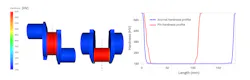
“In the current simulation … generator current and frequency, the crankpin and journal are modelled as separate objects. To account for the pin’s upward motion during rotation, the inductor’s inlet and outlet have been extended to ensure a sufficiently large air domain. Additionally, the inductor geometry has been trimmed laterally to avoid interference with the adjacent shoulder features of the crankpin,” reported Transvalor.
To simulate the behavior of the generator, the simulation software incorporates an iterative algorithm that accurately calculates the frequency and the intensity, in order to maintain constant power equal to the setpoint.
Simulating the induction heating is carried out using two solvers: the first solves the electromagnetic equations and calculates the power density generated by the induced currents; the second solves in a coupled manner the thermal-mechanical-metallurgical equations. The two solvers are linked to update the electromagnetic properties of the parts.
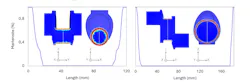
The 3D FEM model makes it possible to evaluate a crankshaft’s final properties, including the depth of the martensite layer and hardness profiles, by studying critical parameters like the current and frequency of the inductor, heating and quenching exposure of the part, part-inductor gap, inductor scanning speed, and quenchant heat-transfer coefficient.
To the crankshaft manufacturer, the simulation makes it possible to quickly conduct a comprehensive evaluation of the induction hardening process, and thereby consider different materials and inductor shapes to achieve desired hardening results.
“Accurate modelling of our in-house induction hardening process will open the doors to improving efficiency and reducing costs within our organization,” according to Bifrangi U.K. metallurgist Teig Coulbeck. “With validated models, we will be able to cut-down on scrap and energy costs by achieving ‘right -first-time’ results. Additionally, this approach will facilitate ongoing improvements through the design and comparison of new coil geometries, ultimately aiming to enhance both our process and the quality of the end product. “