Revolutionizing Automotive Lightweighting with Data-Driven Aluminum Casting
Key Highlights
- The PIVOT project achieved up to 35% weight reduction in aluminum vehicle subframes through data-driven design and simulation.
- Virtual crash testing now complements physical tests, significantly reducing costs and accelerating development cycles.
- Sarginsons plans to develop a near-zero carbon foundry incorporating renewable energy, advanced purification, and sensor-driven processes.
- The Future Foundry project aims to enhance grain-refinement, traceability, and heat treatment techniques for sustainable manufacturing.
- This novel approach promises safer, lighter, and more environmentally friendly automotive components in the near future.
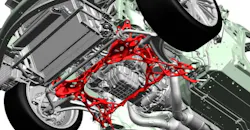
Lightweighting automotive design has been underway for decades, but in the past two years the effort has taken a more data-based approach under a consortium of British research partners. In June, the Performance Integrated Vehicle Optimisation Technology (PIVOT) project revealed some of its results at the "Casting the Future of Aluminium" event hosted at the University of Sheffield’s Advanced Manufacturing Research Centre (AMRC): two cast aluminum automotive subframe structures produced by aluminum foundry Sarginsons Industries according to demonstrator designs by Aston Martin.
Sarginsons is the PIVOT project’s lead partner and coordinator managing the £5.8-million (est. $7.8 million) budget and coordinating collaboration among the other partners, including the automaker, simulation software developer Altair, and Brunel University.
The foundry drew from its own historical records of mechanical testing and microstructural analysis to train the AI-rooted design and digital-twin simulation programs; and it implemented grain-refinement techniques developed at the university.
The two demo vehicle subframes presented the recent event are currently 17% lighter at the front and 35% lighter at the rear than the components they would replace, according to Sarginsons. The two structures were designed using a combination of casting design techniques developed by the PIVOT program partners, drawing on historical data, which allowed Sarginsons to accurately predict how aluminum will behave throughout a casting. This breakthrough capability results in structural components that can be validated using virtual crash simulation
“A physical crash test can cost up to £1 million every time you run one,” Sarginsons’ technical director, Gavin Shipley explained. “For decades, the only way to be safe was to over-engineer, adding mass and material to compensate for uncertainty.
“What we've demonstrated today is an alternative,” Shipley told the AMRC audience, in June. “By combining virtual engineering, AI and advanced casting expertise, we're able to understand precisely how a component will behave before any metal is poured, giving manufacturers the confidence to design for real performance rather than worst-case assumptions.”
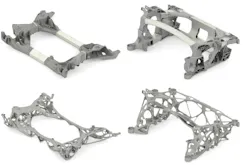
With the virtual testing so far completed, tooling production for the front subframe will be starting soon, and both subframes will be subjected to physical testing to gauge durability, and fitted to demonstrator vehicles for test track trials.
Sarginsons Industries has even more ambitious plans following its award of £650,000 (est. $875,000) in funding from the U.K. government and industrial research bodies to start feasibility studies for its Future Foundry project. That metalcaster strives to establish a “near-zero carbon” operation, drawing together a range of emerging production technologies, including the predictive software, digital-twin simulation, topological optimization, and virtual crash testing deployed with the PIVOT project.
In addition, the Future Foundry project eyes enhanced grain-refinement and additive purification of secondary aluminum alloys. It is also studying laser sorting and QR coding systems to make its secondary alloy supplies cleaner and more traceable. Intelligent tool design and residual stress analysis are in consideration, to engineer "distorted" components that revert to form during heat treatment, to address heat distortion.
Beyond these, Sarginsons’ near-zero carbon foundry may use targeted, sensor-driven cooling sequences within its tooling, to optimize solidification. For sand molding operations, it may adopt inorganic silica materials and renewable energy sources, to eliminate greenhouse gases during mold filling.
Sarginsons’ feasibility study for the Future Foundry is scheduled to be complete in January 2027, followed by scaling-up the existing capabilities. Later plans could expand the near-zero carbon production capacity further.