Technology Trends Lining Up with Robots
Key Highlights
- AI for automation operates within real engineering systems, autonomously programming robots and PLCs while ensuring safety and compliance with industrial standards.
- A new generation of cobots offers high payloads and speeds with no-code programming, making automation accessible and scalable for diverse manufacturing needs.
- Digital twin and virtual commissioning technologies enable manufacturers to simulate and optimize robotic workflows before physical deployment, reducing risks and startup times.
- Integration of autonomous mobile robots with collaborative arms supports flexible, adaptive production layouts, especially in high-mix, low-volume foundry environments.
- AI-powered predictive maintenance and sensor feedback enhance robotic system reliability, minimizing downtime and operational costs in harsh industrial settings.

In January a series of developments in industrial robotics technology and applications were forecast to impact manufacturing business this year - and leading that list is the proliferation of artificial intelligence. The prediction was more specific than that, identifying agentic AI as an emerging robotic programming tool, capable of “complex reasoning, planning, and external tool access to perform sequential tasks, demonstrating proactivity, self-correction, and adaptation to new information.”
Barely five months gone in 2026 and Siemens AG is claiming a breakthrough in agentic AI, explaining that “automation engineers need tools that understand their project context and conform to their organization's specific standards.”
Reasoning out the process
Siemens’ Eigen Engineering Agent is a purpose-built AI for automation engineering, not simply an assistant that generates suggestions but rather a working partner capable of multi-step reasoning and self-correction to carry out tasks autonomously. That means Eigen is ready to be assigned to program industrial robots on its own.
“Unlike generic AI tools, the Eigen Engineering Agent operates inside real engineering systems, with full awareness of each project’s context and constraints,” according to Siemens. “With this understanding, it is able to execute automation engineering tasks like PLC coding, Human-Machine-Interface (HMI) visualization, and device configuration, while meeting industrial standards for correctness, safety, and reliability.”
This brand-agnostic AI agent is forecast to impact not only manual robot programming but to replace manual coding for programmable logic controllers and distributed control systems, updating code or instructions to reflect new priorities and goals.
According to Rainer Brehm, CEO of Siemens’ automation business and CTO for Siemens Digital Industries, the group recognizes from its own business and those of its customers that engineering and reconfiguration constitute 70% of the entire lifecycle cost for a robot. It expects that Eigen (or AI agents in general) can shorten the time needed to make these adjustments, and that will make robots more efficient - and more justifiable to manufacturers that use robots in their operations, or those pondering such investments.
“There’s a kind of new age of automation arising, because [with AI assistance to program robots and PLCs] means you could suddenly automate much smaller lot sizes on a good return of investment,” Brehm said.
Ujjwal Kumar, president of the Americas for Siemens’ Digital Industries Automation, specified that Eigen can help manufacturers deal with a lack of coders and programmers. “We don’t attract the best of the programmers to the manufacturing floor. … So getting programmers to come and code our PLCs or robotic systems? That was a scale up bottleneck. And then add to that, the new generation of people who are coming in, they just know how to do vibe coding. They will not do syntax-based coding anymore,” Kumar said.
“This bringing in AI to reprogram things, reprogram the whole process, will be more game-changing in the U.S. than in Germany, where I see people with Master’s degrees on the manufacturing floor, which is not the case (in the U.S.).”
Cobots encroaching
Affordability is a steady concern for manufacturers evaluating how robots would address their “skills gap.” But the spreading array of robot and cobot capabilities offers new reasons those manufacturers must adjust their evaluations. Cobots continue to make progress in metalcasting workplaces, replacing operators in demanding or dangerous tasks like fettling, grinding, ladle handling, and core handling, among others.
Metalcasters, like most manufacturers, have high demands for the robot team members they consider bringing on board. They may be slightly less resistant to collaborative robots (cobots), which appeal to manufacturers because of their mobility and ease of programming. And being too small for work in metalcasting operations is less of a barrier to adoption than in the recent past.
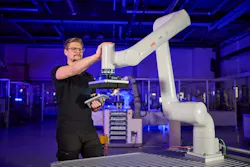
ABB Robotics has introduced a new series of cobots that combine flexibility with high payload capabilities, stating that its PoWa™ cobot family meets the need for industrial-grade performance in collaborative robotics, lowering the barrier to automation for small/midsized enterprises and large businesses.
“Cobots are growing significantly faster than traditional industrial robots, driven by demands from both small and midsized companies starting their automation journey as well as large enterprises,” stated Andrea Cassoni, head of Collaborative Robots at ABB Robotics. “These customers are seeking higher speeds and payloads, but also greater ease of use, and compact designs. Established manufacturers want to automate heavier, fast cycle applications, without the complexity and operational rigidity of traditional industrial robots.”
ABB explained that the PoWa family addresses a gap in the market between traditional cobots that often lack the speed and payload required for industrial applications, and conventional industrial robots, which are designed for highly specialized, large-scale automation environments, going beyond the needs of many collaborative tasks.
PoWa extends ABB Robotics’ cobot portfolio with six different payload categories from 7 to 30 kg, the longest reach and highest arm load on the market and best-in-class top speed of up to 5.8 m/s (for PoWa™ 10 and PoWa™ 13.)
Designed to operate in compact environments and well suited to applications such as high-speed machine tending (among others), PoWa aids manufacturers in automating heavier and faster processes, while maintaining the flexibility, ease of use and compact footprint of collaborative robotics.
The developers emphasize PoWa cobots are easy to use, with programmable buttons on the arm-side interface and no-code programming.
Importantly, they are compatible with an extensive ecosystem of third-party accessories. PoWa can be unboxed and operational “within an hour,” according to ABB, and enables seamless plug-and-play with a wide range of tools, blending industrial-grade connectivity and performance with collaborative robot flexibility.
Powered by the ABB OmniCore™ controller platform, the PoWa cobots offer “best-in-class motion control, speed, and precision and can be integrated with ABB Robotics’ suite of AI-powered software, including Robot Studio® and Wizard Easy Programming, for intuitive programming, fast deployment, and maximum uptime.
Trend lines
Robotics and collaborative automation are becoming increasingly practical for metalcasting operations as advances in AI, sensing, mobility, and digital integration reduce the complexity and rigidity associated with industrial automation. One of the major drivers is “Physical AI,” which allows cobots to learn tasks through sensor feedback and operator guidance rather than extensive manual programming. This capability is valuable in foundries, where high-mix, low-volume production often makes conventional robot programming inefficient and difficult to justify economically.
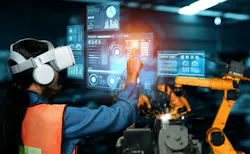
At the same time, digital twin technology and virtual commissioning tools are changing how robotic systems are deployed. Foundries can simulate robotic workflows, validate cell layouts, and optimize process parameters before equipment is installed, reducing commissioning risk, shortening startup time, and improving process reliability. These digital capabilities are increasingly tied into broader connected-manufacturing strategies in which robotic process data feeds MES and ERP systems to improve traceability, quality documentation, and continuous process optimization.
Another important trend is the growing convergence of mobility and manipulation. Robotic systems increasingly combine autonomous mobile robots (AMRs) with collaborative robot arms, enabling flexible material handling and transfer between melting, molding, finishing, and inspection operations. This modular approach supports adaptive production layouts and easier redeployment compared with fixed automation systems.
Human-robot collaboration is evolving now, well beyond the concept of completely “fence-free” robots. A current model emphasizes safe, cooperative work cells that use advanced sensing, configurable guarding, and dynamic speed control to balance safety with productivity.
In terms of ROI
In practice, foundries that embrace automation are prioritizing flexibility, rapid redeployment, and operator usability over fully autonomous or unrestricted human-robot interaction. This aligns well with broader “Industry 5.0” principles that emphasize resilient human-machine collaboration, adaptive production systems, and safer workplaces rather than “lights-out manufacturing.”
As Siemens is explaining, AI-enabled robot programming is lowering barriers to adoption. Natural-language interfaces, AI copilots, and “intent-based robotics” allow operators and engineers to configure tasks, optimize workflows, and troubleshoot systems with less specialized robotics expertise. Combined with modular, pre-engineered cobot cells for applications such as grinding, machine tending, and inspection, these developments significantly reduce deployment time and engineering complexity, making automation more accessible for small and midsize foundries.
Safety and workforce considerations are also strengthening the argument for manufacturers to adopt robots/cobots. Collaborative robotic grinding and finishing cells are used to reduce worker exposure to silica dust, vibration, repetitive-motion injuries, and hot surfaces during casting cleaning. This positions robots in heavy industry as workforce augmentation tools rather than a direct labor replacements. Cobots taking over hazardous, repetitive, and ergonomically difficult tasks leave human operators to focus on supervision, set-up, exception handling, and quality control.
Finally, predictive maintenance and advanced analytics are improving the reliability and uptime of robotic systems in harsh foundry environments. Embedded telemetry and AI-driven monitoring can detect bearing wear, thermal overloads, and process deviations before failures occur, helping reduce unplanned downtime and maintenance costs.
Looking ahead, even humanoid industrial robotics - once largely conceptual - are moving now into pilot deployments, signaling a continued expansion of robotic flexibility and applicability in complex manufacturing environments such as metalcasting.
About the Author
Robert Brooks
Content Director
Robert Brooks has been a business-to-business reporter, writer, editor, and columnist for more than 20 years, specializing in the primary metal and basic manufacturing industries. His work has covered a wide range of topics, including process technology, resource development, material selection, product design, workforce development, and industrial market strategies, among others.