
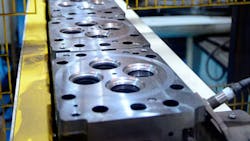
Weaker North American output was a factor in the decline of compacted graphite iron volume during Q4 2025, according to SinterCast AB. The annualized October-December CGI series production of 2.6 million “engine equivalents” - 135,000 metric tons - was down -16% from Q4 2024.
It was the second consecutive quarter of falling CGI series output, though the preceding quarter (Q2 2025) signaled increasing demand.
Stockholm-based SinterCast’s CGI process control technology is licensed by foundries worldwide for series production of engine castings. Its quarterly and annual production volumes are presented as “engine equivalents”, each one equal to 50 kg, in recognition of CGI’s relation to automotive, commercial vehicle, and industrial engine manufacturing.
The company currently has 58 foundries in 13 countries using its process technology to produce CGI.
Compacted graphite iron (CGI) is a lightweight ferrous alloy that offers greater tensile strength, stiffness, and fatigue strength than gray iron or aluminum. It has gained acceptance for casting diesel engines, destined for commercial vehicles and industrial systems.
Despite the falling total for CGI series production during the quarter, SinterCast recorded new series production programs from commercial vehicle and agricultural equipment OEMS, and the start-up of its SinterCast Mini-System 4000 control system at a Chinese foundry.
SinterCast commented that 2025’s late-year decline in output ran parallel to North American commercial vehicle production declining -57% year-over-year, and passenger vehicle production falling -14% in the final quarter of 2025. “Together with reductions in domestic off-road production, the U.S. accounted for an annualized year-on-year decline of approximately 525,000 engine equivalents (26,25o metric tons),” according to SinterCast president and CEO Dr. Steve Dawson’s message included in the company’s quarterly statement.
“In contrast, European commercial vehicle production increased by more than 150,000 engine equivalents (7,500 metric tons) in the fourth quarter, corresponding to year-on-year growth of approximately 20%,” the statement continued. “The increase in Europe shows the onset of market recovery and aligns very well with the industry-wide improvement in commercial vehicle OEM order books and analyst expectations.”
In contrast to the declines in CGI series production, SinterCast reported 2025 “was a prolific year for new product development.” The developer and its foundry licensees landed new high-volume CGI programs with two commercial vehicles manufacturers, to production in 2026 and 2027.
“We also secured two new off-road programs with a major global agricultural OEM that will start production in 2028 and we are currently working on two high-volume commercial vehicle engine programs that will start production in 2030,” Dawson reported.
He also pointed to the anticipated start of the first SinterCast CGI production process in India, in Q2 2026.
As a result of these new CGI production programs, SinterCast is now targeting “an eight million engine equivalent milestone (400,000 metric tons) during 2031, with growth opportunities beyond,” the CEO noted.
About the Author
Robert Brooks
Content Director
Robert Brooks has been a business-to-business reporter, writer, editor, and columnist for more than 20 years, specializing in the primary metal and basic manufacturing industries. His work has covered a wide range of topics, including process technology, resource development, material selection, product design, workforce development, and industrial market strategies, among others.