Advancing the Future of High-Pressure Diecasting
Key Highlights
- Water-free MQL technology reduces thermal stress, extends die life, and minimizes environmental impact compared to traditional water-based systems.
- Advanced automation solutions ensure precise lubricant application, improving casting quality and reducing waste.
- Larger, complex die components in EV manufacturing benefit from innovative lubrication and thermal management, supporting higher throughput and sustainability.
- Electrostatically charged release agents provide uniform coverage on intricate die surfaces, reducing defects and cycle times.
- Transitioning to modern process fluids and automation helps diecasters lower costs, improve safety, and meet evolving industry standards for quality and environmental responsibility.

Diecasting is evolving rapidly, and new innovations and cutting‑edge technologies mean that diecasters must continually optimize their processes to retain a competitive edge. From increasing volume requirements of structural aluminum castings to implementing more digitized manufacturing processes, operations are under pressure to deliver consistent quality with higher throughput and improved sustainability.
Specifically, the development of battery electric vehicles (BEVs) presents a paradigm shift for diecasting. More car manufacturers are adopting larger structural components produced by high‑pressure diecasting, reducing manufacturing steps and vehicle weight, which can improve range. To make that possible, manufacturers are investing in larger, new‑generation, high‑pressure vacuum diecasting machines, often called giga presses, to produce complex, single‑structure castings. Those larger, more complex components introduce new design considerations and manufacturing challenges, especially concerning lubrication, thermal management, and cycle time-control.
Design and lubrication in large‑scale diecasting
Diecasting relies on precise lubrication for optimal performance. Larger structural parts demand intricate die tools that are increasingly difficult to lubricate using conventional, water‑based die-release agents and standard spray systems. Penetrating ribs and deep features is a persistent challenge, and low film‑forming capability can leave critical surfaces under‑protected. Bulky or inflexible spray heads may not reach all areas of the die face, leading to uneven film deposition.
Where lubricant coverage is inconsistent, process control erodes. Hotter regions of the die may experience soldering, while cooler areas accumulate excess lubricant. The consequences include less control of die temperatures, increased die maintenance, reduced die life, and extended cycle times, all of which impact productivity, efficiency, and cost. To reduce energy usage, material consumption, and waste, both equipment and die-release technology must advance in step with the casting programs they support.
Modern release technologies shape performance
Die-release emulsions play a critical role in diecasting processes and directly influence the quality of finished components. Typically, a large proportion of conventional release agent is used primarily for cooling, removing heat introduced by the molten aluminum at the die surface, while also creating a protective layer to prevent sticking and enable easy ejection.
Die-release technologies are commonly categorized as water‑based, water‑based MQL, and water‑free MQL. For decades, diluted water‑miscible die-release agents (wmFT) have been standard in nonferrous diecasting and remain the most common release and cooling approach. However, when casting larger, more complex components and targeting higher productivity at lower cost, the limitations of water‑based systems become increasingly significant.
Limitations, risks of water-based die release
Water‑based emulsions struggle to adapt to the wide range of temperatures found on larger dies. While cooler areas may be adequately protected, hotter regions are susceptible to soldering. The common response - spraying more release agent - often causes overspray and build‑up on cooler surfaces, which leads to lost production time and additional die maintenance.
Thermal cracking is another concern. Intensive quenching with cold, water‑rich release agents generates strong thermal cycling stresses and high residual tensile stress in die surface layers. Over time this promotes fire cracks, which can extend from fractions of a millimeter to well over 50 mm in depth and from a few thousandths of a millimeter to over 2 mm in width.
The presence of water also increases the potential for corrosion of the mold, clamping tools, and associated equipment, further reducing expected die life.
Water‑miscible die lubes can adversely affect part surfaces and internal quality. Brown spots can occur due to burnt‑in wax and oil residues. Corrosion inhibitors used in wmFT can decompose during casting, increasing gases in the system and contributing to porosity.
In addition, the Leidenfrost effect - whereby an insulating vapor layer forms on hot die surfaces - prevents proper wetting, causing droplets to rebound. To overcome this, hot molds require long spray phases to cool the die before a sufficient release film can form, which drives up cycle time.
Operational challenges and safety risks
Build‑up of release agent on mold surfaces and in spray nozzles leads to heavy deposits and even partial spray system failures, increasing unplanned downtime. Casting operations are frequently interrupted to remove soldering or carbon residue from the die. High compressed‑air demand for application and blow‑off increases energy consumption and noise levels.
Typical application pressures (around 2–4 bar) and volumes (12 liters or more per cycle) contribute to overconsumption; a substantial portion of the release agent is effectively used as coolant rather than release film. Heavy overspray generates contaminated wastewater that adds treatment cost and complexity.
Heat and moisture in the diecasting environment can encourage bacterial and fungal growth, resulting in equipment malfunctions, health risks for personnel, and higher maintenance needs. Larger extraction systems may be required to remove water and release agent vapors to mitigate toxicological and direct skin contact hazards. Taken together, these issues create risk exposures for people, equipment and the environment, while driving up consumption of products and energy.
Converting to water‑free MQL technology
Minimum quantity lubrication (MQL) provides targeted, efficient lubricant delivery and addresses many of the inherent drawbacks of water‑based release. In water‑free MQL, success depends on achieving an effective thermal balance in the die, converting available heat intelligently, and reducing both energy and compressed‑air consumption.
Historically, cooling of the die surface was achieved by intensive external spraying. Modern die designs incorporate internal cooling channels created during manufacture, enabling temperature‑regulated diecasting molds that maintain control without external spray cooling. With cooling spray heads positioned close to the surface and appropriate cooling channel distribution across the die face, heat dissipates at the source, allowing selective cooling of hot spots. As a result, the temperature swing between filling and solidification phases is reduced. With channels near the surface and jet cooling for squeezers and known hot areas, cooling via the release agent spray process is no longer required.
Advantages of water‑free MQL lubrication
Tool life and maintenance: By avoiding cold quenching on hot die surfaces, water‑free MQL reduces thermally induced stress and associated fire crack formation. Less overspray and residue reduce the frequency of cleaning interventions and extend the period between maintenance events.
Cycle time and consistency: Shorter spray durations are possible because the spray is not relied upon for cooling, and the air‑blow step commonly used after water‑based application can be eliminated. With no need to cool the die between shots, the cycle becomes more stable and repeatable.
Part quality: Consistent, water‑free films reduce soldering and sticking, improve wetting in complex features, and minimize the Leidenfrost effect. The absence of water during spraying promotes an even distribution of release agent, so surface finish and microstructure are more homogeneous. By reducing porosity drivers, reject rates can be lowered and overall process capability improved.
Environment, health and cost: Removing water from the release step eliminates wastewater generation and reduces the risk of bacterial and fungal growth around the machine. Compressed‑air demand and associated energy consumption decrease as spray and blow‑off phases shorten. The combination of lower lubricant use, less maintenance, fewer rejects, and longer die life leads to a compelling cost and sustainability profile.
Collectively, these improvements help diecasters reduce energy, water and waste disposal while maximizing product quality and supporting sustainability initiatives - particularly important as the industry shifts toward larger, more complex parts.
Water‑free release with smart polymer technology
To support these changes in diecasting technology, Quaker Houghton has developed its DIE SLICK AHK Series – a range of high‑performance water‑free die-release lubricants for aluminum and magnesium diecasting operations. The products are formulated with optimized protection and wetting to resist solder and promote metal flow. Their water‑free chemistry improves die adherence by minimizing the Leidenfrost effect and reduces thermal shock, supporting extended die life.
DIE SLICK AHK Series agents can be applied electrostatically or non‑electrostatically. When charged electrostatically, the technology creates a wrap‑around effect that improves deposition efficiency and coverage uniformity across complex die faces. The film that forms is tough and resists soldering and part sticking. Castings are bright and clean and do not create downstream paint or coating problems. The series also helps minimize smoke and avoid staining during production.
Grades in the range are designed for elevated application temperatures, with maximum die-face temperature capabilities that vary by grade. This supports use on demanding structural applications. such as engine blocks, transmission casings, battery housings and structural body‑in‑white components where coverage, release reliability and surface finish are critical.
Efficiently maximizing coverage, automatically
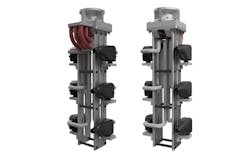
As programs move to complex single‑piece components, achieving a consistent level of lubricant coverage across the entire die face is essential. Areas that collect excess water‑based lubricant—such as deep cavities—are prone to cold flow, porosity and staining. Quaker Houghton’s fully digital and automated fluid management solution, QH FLUID INTELLIGENCE™ include the The QH FLUIDCONTROL™ DAS system, which addresses consistency issues by delivering high adhesion efficiency and effective film formation with significantly reduced lubricant volume.
QH FLUIDCONTROL™ DAS is lightweight and highly customizable. It applies a precise mist of release agent directly to die surfaces, minimizing waste and maximizing efficiency. The system can be configured with 1 to 24 nozzles for targeted lubrication tailored to specific die size and geometry. It is readily expandable with features such as ultraviolet lamps for enhanced mold inspection and temperature sensors for real‑time monitoring of thermal conditions.
Operationally, QH FLUIDCONTROL™ DAS reduces lubricant consumption and maintenance needs compared to flood‑style cooling. Precise lubrication lowers friction and heat buildup, which helps extend die life. Consistent deposition improves casting results, minimizing rejects and supporting higher yield. A cleaner work environment is another benefit, since the approach eliminates the mess and hazards associated with traditional flood cooling. When combined with DIE SLICK® AH K—especially in electrostatic mode—the system further reduces soldering, provides full and uniform coverage on complex dies, and enables reduced spray time with a lower reject rate. The absence of water in the process means no release‑related wastewater is generated, and lower air‑blow requirements contribute to improved environmental performance.
Meeting tomorrow's challenges today
The evolution of high-pressure diecasting is inseparable from the evolution of the technologies that enable it. As manufacturers embrace larger structural components and giga presses to meet the demands of battery electric vehicles and next-generation mobility, the need for advanced process fluids and intelligent automation has never been more critical.
Water-free MQL technology represents more than an incremental improvement—it's a fundamental shift in how diecasters approach lubrication, thermal management, and process control. By eliminating the thermal shock, maintenance burden, and environmental impact of conventional water-based systems, manufacturers can extend die life, accelerate cycle times, improve part quality, and reduce total cost of ownership.
About the Author
Zach White
Senior Manager, Global Die Casting
Zach White is the Senior Manager, Global Die Casting with Quaker Houghton. Contact him at LinkedIn.