Thermally Reliable Diecasting Processes
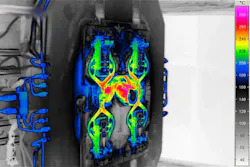
INFRATEC’s new Diecast-Check automation solution lets users monitor temperature distribution of casting molds inline. The system detects thermal deviations at an early stage and thus creates the conditions for stabilizing diecasting processes, reliably securing the quality of the castings and reducing rejects.
Unlike point-by-point measurement methods with pyrometers or thermocouples, Diecast-Check provides a complete thermographic image of the shaping tool surface (“cavity”). Critical zones of the casting mold can thus be made visible and targeted corrections can be made in the ongoing process. The thermographic measurements also provide important data to optimize the quality of the diecasting and the cycle times of the process.
The acquired temperature data can also be processed for each individual production cycle using AI-supported algorithms. In this way, patterns of the tool temperature can be analyzed over different batches and e.g. B. Draw conclusions about the more uniform heating of the casting mold.
Temperature deviations as sources of error
Diecasting takes place in narrow thermal windows and in short cycle times. Even low temperature deviations on the cavity can affect the quality of the casting. The deviations occur in particular in the warm-up and start-up phase. Reliable inline temperature monitoring is therefore a prerequisite for making the process efficient.
Reliable measurements in challenging environments
As part of the Diecast-Check solution, high-resolution thermal imaging cameras reliably detect temperature deviations that occur, even in complex, finely structured components. However, the non-contact and area-like temperature measurement during diecasting is technically very demanding due to the adverse environmental conditions. In order to be able to detach the component more easily after diecasting, the mold is sprayed with a release agent before each casting process. The optical components of the thermography cameras used in the immediate process environment must be protected from the spray and dirt produced during the separation process.
A special, very robust protective housing was developed in particular for the high requirements of this “lubrication phase” together with an industrial partner. This housing has a precisely controlled protective flap (shutter) and an air flush, which prevents contamination of the Germanium protection window integrated in the housing. This ensures the functionality of the entire measuring system and cleaning is only required after long service life.
Diecast-Check-Software: temp monitoring, alarms, and process assessment
The automation solution is integrated into the process control of the diecasting cell via industrially customary interfaces. The Diecast-Check software used is a variant of InfraTec’s Indu-Scan software, which is specially tailored to the monitoring of diecasting processes. It delivers data to the higher-level system control, visualizes the process data on a control screen and stores all measured values.
The temperature data is automatically recorded and recorded after the release agent has been applied. The user interface of the Diecast Check software shows the temperature images of the casting mold in real time. The time temperature curves can also be graphically represented and evaluated. For the evaluation, various regions of interest (ROI) can also be defined, which enable targeted monitoring of particularly critical areas for component quality.
If the temperature of the casting mold measured by the system is within the specified limits, the die-cast part produced is evaluated as “in order” and the cycle continues to run. If limit values are exceeded or fallen below, the system triggers an alarm and marks affected areas with too high or too low temperatures. The data is transferred to the machine control, which triggers the necessary heating or cooling of the casting mold.
With the Diecast Check software, other parameters are monitored in addition to the temperature. This includes the contact of the compressed air on the camera protection housing, the error-free work of the shutter flap or the need to clean the viewing window.
Learn more at www.infratec.de