Rethinking Reverberatory vs. Shaft Melting
Key Highlights
- Shaft melting furnaces offer superior energy efficiency and metal yield compared to traditional reverberatory systems, leading to cost savings and environmental benefits.
- Furnace selection should be driven by actual production requirements, charge characteristics, and operational goals rather than defaulting to familiar reverberatory technology.
- Modern shaft furnaces incorporate heat recovery by design, reducing energy consumption and supporting more sustainable foundry operations.
- Assessing furnace availability, maintenance needs, and modernization options is crucial for maximizing ROI and ensuring reliable production capacity.
- Foundries should base their equipment decisions on comprehensive performance data and real-world operational factors to optimize efficiency and growth potential.

The U.S. aluminum casting market is forecast to grow by 5.1% annually through 2033, and foundries face important capacity decisions – especially when selecting melting equipment. Comparative data shows that shaft melting can offer greater energy efficiency than reverberatory melting. Treating reverb technology as the familiar default risks overlooking this advantage, as well as other considerations that determine overall suitability and cost per usable pound – including charge mix, metal yield, holding demand, utilization, maintenance, and furnace availability.
A 2016 U.S. Energy Star guide reported that reverberatory furnaces accounted for about 95% of U.S. aluminum melting. The figure is dated; the current share unclear. Nevertheless, it’s still true to say that reverberatory technology remains deeply entrenched in U.S. foundries.
Relying on this established position may reveal metalcasters’ effort to minimize risk when they’re considering new melting capacity. Teams know the equipment and maintenance practices are in place, and the plant may already be arranged around it. But familiarity is not a performance specification, and growth seldom occurs without intentional change. If discussions begin with which reverberatory furnace to buy, rather than which furnace best fits the production goals, the potential advantages of shaft melting may be overlooked.
How each furnace uses heat
A reverberatory furnace heats the charge and molten bath from above, with heat transferred mainly from the flame and refractory roof. It is a familiar and simplistic approach available in large capacities and different charging configurations. Preheated hearths, metal circulation, insulation advances, and recuperative or regenerative combustion may improve modern offerings; however, by principal of design there are limitations to achievable efficiency, metal yield, and metal quality.
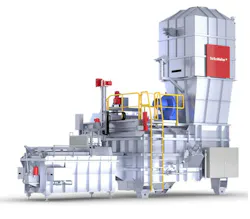
A vertical shaft - also called a stack or tower - uses a different approach: a ‘counter-flow principle.’ A solid charge descends through the shaft as hot exhaust gases rise within it, preheating the material before it reaches the melting zone. Integrated systems can also control separate melting and holding chambers independently. Unlike a reverberatory furnace, where heat recovery requires additional equipment, a shaft furnace incorporates heat recovery by design. The hot exhaust gases automatically preheat the incoming charge, maximizing energy utilization before melting.
The energy-saving case for shaft melting
Generic figures can mislead because charge geometry, alloy, target temperature, utilization, holding duty and measurement boundaries affect performance. A useful comparison controls those variables instead of placing two brochure figures side by side.
One plant study did exactly that. It compared furnaces rated at 3,000 lbs./hr. using the same A356 alloy, ingot-to-return ratio and operators. The shaft melting furnace consumed 955 Btu/lbs., versus 1,975 Btu/lbs. for the reverberatory furnace. Melt loss was 0.9% versus 5.5%, and the tap-temperature range was +/-5 F versus +/-32 F.
More recently, the European Commission’s 2024 foundry reference document reports typical thermal efficiency of 20-25% for reverberatory furnaces and 35-65% for shaft furnaces. Its indicative specific-energy demand is 1,509 - 1,780 BTU/lbs. (975 - 1,150 kWh/t) of molten aluminum for reverberatory melting and 836 - 1,393 BTU/lbs. (540 - 900 kWh/t) for shaft melting. Our own research using real foundry conditions has shown StrikoMelter® PUREFFICIENCY achieves consumption as low as 757 BTU/lbs. (489 kWh/t.)
Metal yield also changes the equation
Energy appears clearly on a utility bill; metal loss can be harder to see. Yet, for a foundry charging 10 million lbs. annually, a one-percentage-point improvement in measured melt yield makes another 100,000 lbs. of liquid metal available for casting. At an assumed aluminum value of approximately $2.60/lbs. in summer 2026, that is about $260,000 in metal value, although replacement cost will of course vary by alloy and purchasing arrangements.
In addition, if less of a charge reaches the point of casting, more material must be bought or remelted to produce the same output. That adds energy, furnace time, handling and dross processing while consuming capacity that could support productive output.
Energy and yield should therefore be assessed together through cost per usable pound of molten aluminum.
Any yield figure needs a clear basis: a complete metal balance compares all charge material entering the furnace with liquid metal leaving over a defined period. Dross weight alone is insufficient because it contains oxides and recoverable aluminum.
At StrikoWestofen, we assessed StrikoMelter performance by weighing all incoming and outgoing metal flows rather than estimating loss from dross weight. With standard diecasting alloys, this method has measured yields of up to 99%.
Consider how much metal you hold
A large holding bath provides a production buffer, but it also keeps more aluminum at temperature. This increases energy consumption and promotes dross formation. Where demand is predictable, reducing the bath size can improve efficiency and support a leaner operation.
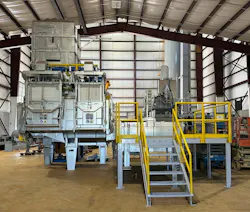
Shaft melting furnaces offer a compact solution that can be installed directly alongside the molding line. Depending on throughput requirements, they are available in compact “over-under” configurations for the smallest footprint, as well as larger designs with separate melting and holding chambers. These larger systems can accommodate higher throughput while maintaining tighter temperature control.
Cast Products Inc. (CPI) selected a shaft melter as part of its $6.7-million automated foundry expansion in Athens, AL. The 30,000-square-foot foundry expansion includes a gas-fired StrikoMelter with an HBT (Holding, Bale, and Treat) unit.
After visiting operating foundries and assessing an electric reverberatory option, CPI selected the StrikoMelter based on several critical factors, including its footprint, maintenance requirements, melt quality, and its ability to achieve the required melt rate without a large holding bath.
“The StrikoMelter has become a key part of our new automated foundry,” said Colby Medlen, CPI’s chief operating officer. “It provides the melt rate we need, requires very little operator intervention, and has proved to be extremely reliable and consistent. We are seeing the benefits in both production throughput and utility consumption.”
Match furnace to real charge and demand
A foundry’s choice of a furnace also must reflect the material the foundry actually melts. A standard shaft configuration is a natural fit for ingots and appropriately sized production returns. Other charge forms do not necessarily rule out shaft melting, but they may require a different configuration. At StrikoWestofen, for example, we developed BigStruc for large, thin-walled structural returns, and CombiMelter for chips.
Reverberatory melting still may be considered if very large batch capacity is required, or the building height limits a shaft installation. The key consideration for the foundry is to define the complete charge mix – including dimensions, bulk density, and the proportion of ingot and returns.
Production profile matters too. Continuous, predictable demand allows a shaft furnace to use its heat-recovery principle consistently. Charging at the correct time, with the right volume and material mix, while maintaining the optimal shaft filling level, supports efficient operation.
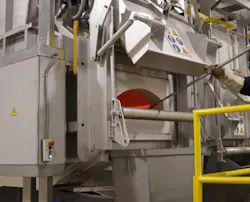
Options such as a shaft laser scanner, part-load efficiency control, and automatic charging can help maintain these conditions. Utilization also affects reverberatory furnaces: if the furnace chamber and refractory roof cool between charging cycles, additional energy is needed to restore operating temperature.
Therefore, foundries should compare furnace options against their actual production requirements – not just the maximum quoted melt rate.
Calculate for availability, adaptability
Whatever performance figures are quoted, a furnace has to be available for production before they can be achieved. Availability (essentially, up time) figures are therefore hugely important. Suppliers should be happy to explain how they are calculated, whether planned maintenance is included, and the operating conditions on which they are based.
Foundries should ask about furnace design features and service options that can reduce maintenance requirements or shorten interventions, together with modernization routes that can extend service life or adapt the furnace to changing production needs.
Technical support, spare-parts availability, and modernization capability are part of the furnace investment and ROI decision – not simply considerations for after installation.
Change the starting point
No single furnace configuration suits every aluminum foundry. The conclusion is not that reverberatory melting is obsolete or that shaft melting is always better. It is that an incumbent technology should not become the automatic choice simply because it is familiar.
Familiarity alone cannot identify the right solution. A better starting point is to ask: Which system will better suit the foundry’s operation, respecting safety and reliability to support the production requirements, while delivering the lowest cost per usable pound over its service life?
For many foundries, the answer will point toward shaft melting. For others, it will not. Either way, the decision should be based on the real production case – not an inherited assumption about which technology to buy.
About the Author
Aaron Kostuch
Regional Account Manager
Aaron Kostuch is StrikoWestofen's Midwest regional account manager. He has more than 10 years of expertise in melting, holding, and dosing solutions for the foundry and diecasting industries, complemented by a background in high-tech manufacturing processes.